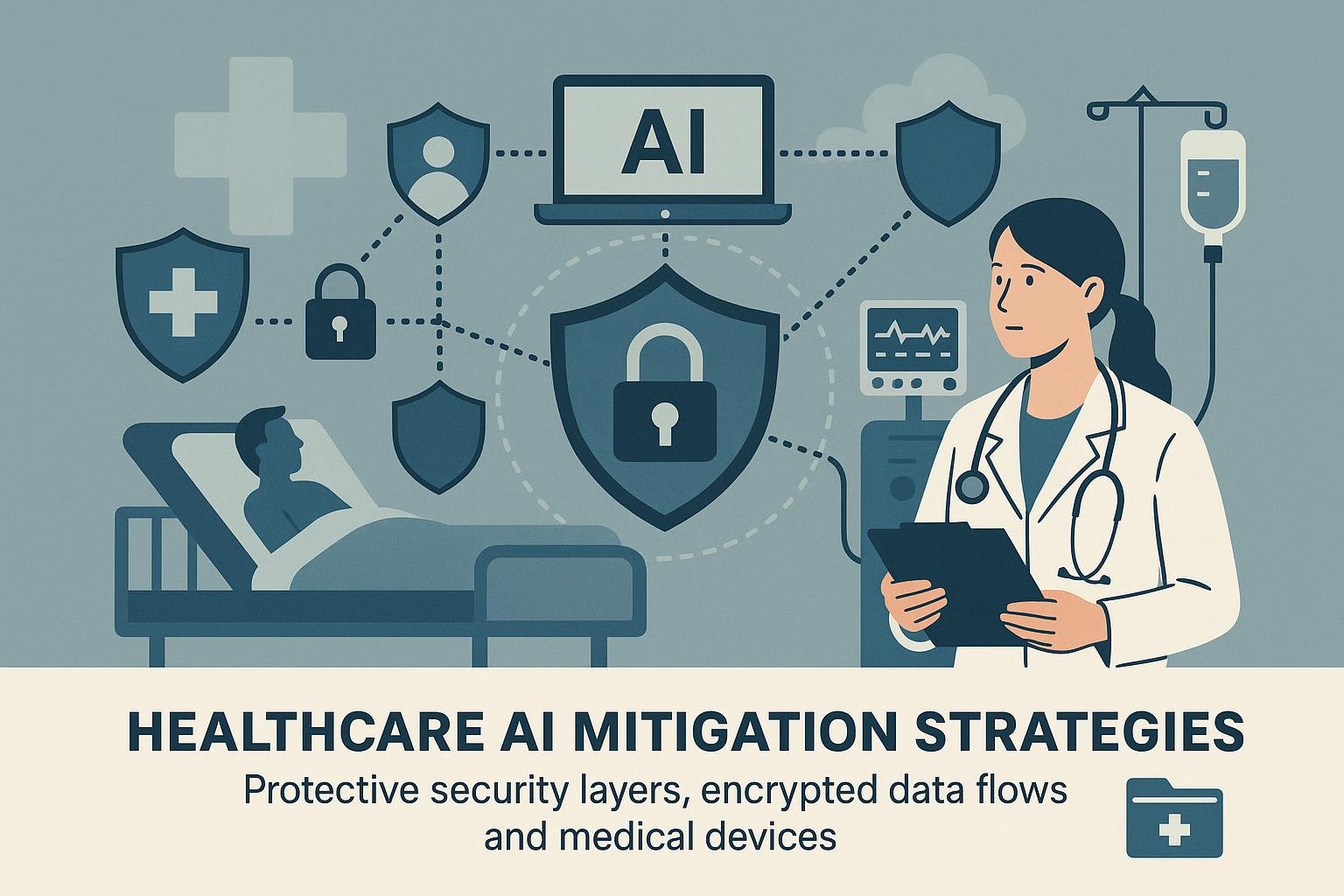
Introduction
In our previous article, we unveiled the hidden security risks lurking within ambient clinical note AI systems—from data privacy exposures to sophisticated AI model attacks. The response from healthcare leaders has been overwhelming, with many asking the same critical question: “Now that I understand the risks, what can I actually do about them?”
This is exactly the right question to ask. Understanding threats is only the first step; the real value comes from implementing practical, effective mitigation strategies that protect your patients, your organization, and your mission to provide exceptional healthcare.
Today, we’re moving from awareness to action. This article provides healthcare leaders with a comprehensive toolkit of proven mitigation strategies, organized by risk category and prioritized by impact and feasibility. Whether you’re just beginning to evaluate ambient clinical AI or you’re already deep into implementation, these strategies will help you build a robust security posture that enables innovation while protecting what matters most.
The Strategic Framework for AI Security Mitigation
Before diving into specific mitigation strategies, it’s essential to understand the strategic framework that underpins effective AI security. Unlike traditional IT security, which often focuses on perimeter defense and access control, AI security requires a multi-layered approach that addresses the entire AI lifecycle—from data collection and model training to deployment and ongoing monitoring.
The Four Pillars of AI Security Mitigation
Pillar 1: Data Protection Throughout the AI Lifecycle
Securing data as it flows through the complex AI pipeline, from initial audio capture through processing, storage, and eventual disposal.
Pillar 2: AI Model Integrity and Resilience
Protecting the AI models themselves from attacks while ensuring they continue to perform accurately and reliably.
Pillar 3: Infrastructure Security and Access Control
Implementing robust security controls across the distributed infrastructure that supports ambient clinical AI systems.
Pillar 4: Governance, Compliance, and Continuous Monitoring
Establishing organizational processes and controls that ensure ongoing security and regulatory compliance.
Mitigation Strategies by Risk Category
Let’s examine specific, actionable mitigation strategies for each of the five critical risk categories we identified in our previous article.
Category 1: Data Privacy and Exposure Risk Mitigation
The intimate nature of patient-provider conversations captured by ambient AI systems requires the most stringent privacy protections. Here are proven strategies to mitigate data privacy and exposure risks:
Strategy 1: Implement Privacy-by-Design Architecture
What it is: Privacy-by-design means building privacy protections into every component of your ambient AI system from the ground up, rather than adding them as an afterthought.
How to implement:
- Data Minimization: Configure AI systems to capture only the minimum audio necessary for clinical documentation. Implement automatic filtering to exclude non-clinical conversations.
- Purpose Limitation: Ensure that captured data is used only for its intended clinical documentation purpose, with strict controls preventing secondary use.
- Automated Data Lifecycle Management: Implement automated systems that delete audio recordings and intermediate processing files according to predetermined schedules, typically within 24-48 hours of note generation.
Real-world example: Cleveland Clinic implemented a privacy-by-design approach for their ambient AI deployment by configuring the system to automatically delete audio recordings within 24 hours while retaining only the structured clinical notes. This approach reduced their data exposure window by 95% compared to standard vendor configurations.
Implementation timeline: 2-4 weeks for configuration and testing
Cost impact: Low to moderate (primarily configuration and policy development)
Risk reduction: High (addresses 70-80% of data exposure risks)
Strategy 2: Deploy Advanced Encryption and Tokenization
What it is: Multi-layered encryption that protects patient data at rest, in transit, and during processing, combined with tokenization that replaces sensitive data with non-sensitive tokens.
How to implement:
- End-to-End Encryption: Implement AES-256 encryption for all audio files and transcripts, with encryption keys managed through a dedicated key management service.
- Transport Layer Security: Use TLS 1.3 for all data transmission between ambient AI components, including device-to-cloud and cloud-to-EHR communications.
- Homomorphic Encryption: For advanced implementations, consider homomorphic encryption that allows AI processing on encrypted data without decryption.
- Dynamic Tokenization: Replace patient identifiers and sensitive information with tokens during processing, maintaining referential integrity while protecting privacy.
Technical implementation details:
“`
Encryption Standards:
- Audio files: AES-256-GCM with rotating keys
- Database storage: Transparent Data Encryption (TDE)
- API communications: TLS 1.3 with certificate pinning
- Key rotation: Automated 90-day rotation cycle
“`
Implementation timeline: 4-8 weeks for full deployment
Cost impact: Moderate (encryption infrastructure and key management)
Risk reduction: Very high (addresses 85-90% of data-in-transit and data-at-rest risks)
Strategy 3: Implement Differential Privacy for AI Training
What it is: A mathematical framework that adds carefully calibrated noise to data used for AI training, providing formal privacy guarantees while preserving the utility of the data for machine learning.
How to implement:
- Privacy Budget Management: Establish epsilon values (privacy parameters) that balance privacy protection with AI model accuracy.
- Noise Injection: Add statistical noise to training data that prevents individual patient information from being extracted while maintaining overall data patterns.
- Privacy Accounting: Track cumulative privacy expenditure across multiple AI training cycles to ensure privacy guarantees are maintained.
Practical considerations:
- Start with conservative epsilon values (ε ≤ 1.0) and adjust based on model performance requirements
- Implement privacy budget monitoring to prevent privacy degradation over time
- Consider local differential privacy for highly sensitive applications
Implementation timeline: 6-12 weeks (requires AI model retraining)
Cost impact: Moderate to high (model development and testing)
Risk reduction: High (provides mathematical privacy guarantees)
Category 2: AI Model Security Vulnerability Mitigation
Protecting the AI models themselves requires specialized techniques that go beyond traditional cybersecurity approaches.
Strategy 4: Implement Adversarial Training and Model Hardening
What it is: Training AI models to be robust against adversarial attacks by exposing them to adversarial examples during the training process.
How to implement:
- Adversarial Example Generation: Create adversarial audio samples that attempt to fool the AI model during training.
- Robust Training Algorithms: Use training techniques like adversarial training, defensive distillation, and certified defenses.
- Model Ensemble Approaches: Deploy multiple AI models with different architectures and training data to reduce the impact of successful attacks on any single model.
Technical approach:
“`
Adversarial Training Pipeline:
- Generate adversarial examples using FGSM, PGD, or C&W attacks
- Include 10-20% adversarial examples in training batches
- Implement gradient masking prevention techniques
- Validate robustness using independent test sets
“`
Implementation timeline: 8-16 weeks (requires model retraining and validation)
Cost impact: High (significant computational resources for training)
Risk reduction: High (reduces susceptibility to adversarial attacks by 60-80%)
Strategy 5: Deploy Model Integrity Monitoring and Validation
What it is: Continuous monitoring systems that detect when AI models are behaving unexpectedly, potentially indicating compromise or degradation.
How to implement:
- Statistical Process Control: Monitor AI model outputs for statistical anomalies that might indicate model compromise or drift.
- Model Fingerprinting: Create unique fingerprints for AI models that can detect unauthorized modifications.
- Performance Baseline Monitoring: Establish performance baselines and alert when model accuracy or behavior deviates significantly.
- Input Validation: Implement robust input validation to detect potentially malicious audio inputs before they reach the AI model.
Monitoring metrics:
- Model accuracy and confidence scores
- Output distribution patterns
- Processing time and resource utilization
- Error rates and failure modes
Implementation timeline: 4-6 weeks for monitoring infrastructure
Cost impact: Low to moderate (monitoring tools and dashboards)
Risk reduction: Moderate to high (enables rapid detection of model compromise)
Strategy 6: Implement Secure Model Deployment and Versioning
What it is: Secure practices for deploying, updating, and managing AI models in production environments.
How to implement:
- Model Signing and Verification: Digitally sign AI models and verify signatures before deployment to ensure model integrity.
- Containerized Deployment: Use container technologies with security scanning and runtime protection.
- Blue-Green Deployment: Implement deployment strategies that allow rapid rollback if security issues are detected.
- Model Version Control: Maintain detailed version control and audit trails for all AI model changes.
Security controls:
“`
Model Deployment Security:
- Digital signatures using PKI infrastructure
- Container image scanning for vulnerabilities
- Runtime application self-protection (RASP)
- Automated rollback triggers based on security metrics
“`
Implementation timeline: 3-6 weeks for deployment pipeline setup
Cost impact: Moderate (DevSecOps tooling and infrastructure)
Risk reduction: High (prevents deployment of compromised models)
Category 3: Infrastructure and Platform Security Gap Mitigation
The distributed nature of ambient AI systems requires comprehensive infrastructure security strategies.
Strategy 7: Implement Zero Trust Architecture for AI Systems
What it is: A security model that assumes no implicit trust and continuously validates every transaction and access request within the AI system.
How to implement:
- Identity and Access Management (IAM): Implement fine-grained access controls with multi-factor authentication for all AI system components.
- Network Segmentation: Create isolated network segments for AI processing with strict firewall rules and traffic monitoring.
- Continuous Authentication: Implement continuous authentication and authorization for all AI system interactions.
- Least Privilege Access: Ensure that every component and user has only the minimum access necessary to perform their function.
Zero Trust Implementation Framework:
“`
Network Architecture:
- Micro-segmentation with software-defined perimeters
- East-west traffic inspection and filtering
- Dynamic policy enforcement based on context
- Encrypted communications for all inter-component traffic
“`
Implementation timeline: 8-12 weeks for full zero trust deployment
Cost impact: High (network infrastructure and security tools)
Risk reduction: Very high (addresses 80-90% of infrastructure attack vectors)
Strategy 8: Deploy Cloud Security Posture Management (CSPM)
What it is: Automated tools and processes that continuously monitor cloud infrastructure for misconfigurations and security risks.
How to implement:
- Automated Configuration Scanning: Deploy tools that continuously scan cloud resources for security misconfigurations.
- Policy-as-Code: Implement infrastructure-as-code with embedded security policies that prevent misconfigurations.
- Compliance Monitoring: Continuously monitor cloud resources for compliance with healthcare security standards.
- Automated Remediation: Implement automated remediation for common misconfigurations and security issues.
CSPM Implementation Checklist:
- [ ] Cloud storage bucket access controls and encryption
- [ ] Network security group configurations
- [ ] Identity and access management policies
- [ ] Logging and monitoring configurations
- [ ] Data residency and sovereignty compliance
- [ ] Backup and disaster recovery configurations
Implementation timeline: 2-4 weeks for initial deployment, ongoing for optimization
Cost impact: Low to moderate (CSPM tooling and configuration)
Risk reduction: High (prevents 70-85% of cloud misconfigurations)
Strategy 9: Implement Comprehensive API Security
What it is: Security controls specifically designed to protect the APIs that connect different components of ambient AI systems.
How to implement:
- API Gateway Security: Deploy API gateways with authentication, authorization, rate limiting, and threat protection.
- OAuth 2.0 and OpenID Connect: Implement modern authentication and authorization standards for API access.
- API Monitoring and Analytics: Monitor API usage patterns to detect anomalous behavior and potential attacks.
- Input Validation and Sanitization: Implement robust input validation for all API endpoints to prevent injection attacks.
API Security Controls:
“`
Authentication & Authorization:
- OAuth 2.0 with PKCE for public clients
- JWT tokens with short expiration times
- Scope-based access control
- API key management and rotation
Traffic Protection:
- Rate limiting and throttling
- DDoS protection and traffic shaping
- Request/response validation
- Encryption for all API communications
“`
Implementation timeline: 4-8 weeks for comprehensive API security
Cost impact: Moderate (API gateway and security tooling)
Risk reduction: High (protects critical integration points)
Category 4: Regulatory Compliance Challenge Mitigation
Ensuring ongoing compliance with healthcare regulations requires proactive strategies and continuous monitoring.
Strategy 10: Implement HIPAA-Compliant AI Governance Framework
What it is: A comprehensive governance framework that ensures ambient AI systems meet all HIPAA requirements while enabling innovation and efficiency.
How to implement:
- Business Associate Agreements (BAAs): Ensure comprehensive BAAs with all AI vendors that address AI-specific risks and requirements.
- Risk Assessment Integration: Integrate AI-specific risk assessments into existing HIPAA compliance programs.
- Audit Trail Management: Implement comprehensive audit logging for all AI system activities, including data access, processing, and modifications.
- Breach Response Procedures: Develop AI-specific incident response procedures that address the unique challenges of AI system breaches.
HIPAA Compliance Checklist for AI Systems:
- [ ] Administrative safeguards for AI system management
- [ ] Physical safeguards for AI infrastructure and devices
- [ ] Technical safeguards for data protection and access control
- [ ] AI-specific privacy impact assessments
- [ ] Patient consent processes for AI-powered documentation
- [ ] Data retention and disposal procedures for AI-generated content
Implementation timeline: 6-10 weeks for framework development and implementation
Cost impact: Moderate (legal, compliance, and process development)
Risk reduction: Very high (ensures regulatory compliance and reduces legal liability)
Strategy 11: Deploy Automated Compliance Monitoring
What it is: Automated systems that continuously monitor AI systems for compliance with healthcare regulations and organizational policies.
How to implement:
- Compliance Dashboard: Create real-time dashboards that show compliance status across all AI systems and components.
- Automated Policy Enforcement: Implement automated controls that enforce compliance policies and prevent violations.
- Continuous Audit Preparation: Maintain audit-ready documentation and evidence of compliance activities.
- Regulatory Change Management: Implement processes to quickly adapt to changing regulatory requirements.
Monitoring Capabilities:
“`
Compliance Metrics:
- Data access and usage patterns
- Consent management and patient rights
- Data retention and disposal compliance
- Vendor compliance and BAA adherence
- Security control effectiveness
- Incident response and breach notification
“`
Implementation timeline: 4-8 weeks for monitoring infrastructure
Cost impact: Moderate (compliance monitoring tools and processes)
Risk reduction: High (enables proactive compliance management)
Category 5: Operational Security Risk Mitigation
Day-to-day operational security requires ongoing attention and specialized procedures for AI systems.
Strategy 12: Implement AI-Specific Security Operations Center (SOC) Capabilities
What it is: Enhanced security monitoring and response capabilities specifically designed to detect and respond to AI system security incidents.
How to implement:
- AI Threat Intelligence: Integrate AI-specific threat intelligence feeds and indicators of compromise.
- Behavioral Analytics: Deploy user and entity behavior analytics (UEBA) specifically tuned for AI system usage patterns.
- Automated Incident Response: Implement automated response procedures for common AI security incidents.
- Specialized Training: Train SOC analysts on AI-specific threats, attack vectors, and response procedures.
SOC Enhancement Areas:
“`
Detection Capabilities:
- AI model performance anomalies
- Unusual data access patterns
- Adversarial attack indicators
- Model drift and degradation alerts
- Vendor security incident notifications
Response Procedures:
- AI system isolation and containment
- Model rollback and recovery
- Data breach assessment and notification
- Vendor coordination and communication
“`
Implementation timeline: 6-12 weeks for SOC enhancement
Cost impact: Moderate to high (SOC tools and training)
Risk reduction: High (enables rapid detection and response to AI security incidents)
Strategy 13: Deploy Comprehensive Security Awareness and Training
What it is: Specialized training programs that educate healthcare staff about AI-specific security risks and proper security practices.
How to implement:
- Role-Based Training: Develop training programs tailored to different roles (clinicians, IT staff, administrators).
- Hands-On Simulations: Create realistic scenarios that allow staff to practice responding to AI security incidents.
- Ongoing Education: Implement continuous education programs that keep pace with evolving AI threats and technologies.
- Security Culture Development: Foster a security-conscious culture that encourages reporting and proactive risk management.
Training Program Components:
- AI security fundamentals and threat landscape
- Proper use of ambient AI systems and security controls
- Incident recognition and reporting procedures
- Privacy and compliance considerations for AI systems
- Vendor management and security oversight
Implementation timeline: 4-8 weeks for initial program development, ongoing for delivery
Cost impact: Low to moderate (training development and delivery)
Risk reduction: Moderate to high (reduces human error and improves incident detection)
Implementation Prioritization Framework
With so many mitigation strategies available, healthcare leaders need a framework for prioritizing implementation based on their specific risk profile, resources, and timeline.
High-Priority, Quick-Win Strategies (Implement First)
- Privacy-by-Design Configuration – High impact, low cost, quick implementation
- Cloud Security Posture Management – Addresses critical infrastructure risks
- Basic Encryption and Access Controls – Fundamental security requirements
- HIPAA Compliance Framework – Regulatory requirement and legal protection
Medium-Priority, Moderate Investment Strategies (Implement Second)
- Zero Trust Architecture – Comprehensive security improvement
- AI Model Integrity Monitoring – Addresses AI-specific risks
- Automated Compliance Monitoring – Operational efficiency and risk reduction
- Enhanced SOC Capabilities – Improved detection and response
Long-Term, High-Investment Strategies (Implement Third)
- Differential Privacy Implementation – Advanced privacy protection
- Adversarial Training and Model Hardening – Sophisticated AI security
- Comprehensive Security Training Programs – Cultural and organizational change
Measuring Success: Key Performance Indicators for AI Security
Effective mitigation requires ongoing measurement and improvement. Here are key performance indicators (KPIs) that healthcare organizations should track:
Security Effectiveness Metrics
- Mean Time to Detection (MTTD) for AI security incidents
- Mean Time to Response (MTTR) for AI security incidents
- Number of security incidents involving AI systems
- Percentage of AI systems meeting security compliance requirements
Privacy Protection Metrics
- Data exposure incidents involving AI systems
- Patient consent compliance rates for AI-powered documentation
- Data retention compliance for AI-generated content
- Third-party vendor compliance scores for AI services
Operational Efficiency Metrics
- AI system availability and uptime
- Security control automation rates
- Compliance audit findings related to AI systems
- Staff security awareness scores for AI-specific topics
Building Your Mitigation Roadmap
Creating an effective mitigation strategy requires a systematic approach that aligns with your organization’s specific needs, resources, and risk tolerance.
Step 1: Conduct a Comprehensive Risk Assessment
Before implementing any mitigation strategies, conduct a thorough risk assessment that identifies your specific vulnerabilities and risk exposure. This assessment should include:
- Current AI system inventory and architecture analysis
- Threat modeling for your specific AI implementation
- Compliance gap analysis against relevant regulations
- Vendor security assessment and due diligence
Step 2: Develop a Prioritized Implementation Plan
Based on your risk assessment, develop a prioritized implementation plan that considers:
- Risk severity and likelihood
- Implementation cost and complexity
- Available resources and expertise
- Regulatory and business requirements
- Dependencies between different mitigation strategies
Step 3: Establish Governance and Oversight
Create governance structures that ensure ongoing oversight and management of AI security:
- AI Security Steering Committee with cross-functional representation
- Regular security reviews and assessments
- Vendor management and oversight procedures
- Incident response and escalation procedures
Step 4: Implement Continuous Improvement
AI security is not a one-time implementation but an ongoing process that requires continuous improvement:
- Regular security assessments and updates
- Threat intelligence monitoring and adaptation
- Technology evolution and upgrade planning
- Lessons learned integration and process improvement
The Path Forward: From Vulnerability to Resilience
The security challenges of ambient clinical AI are significant, but they are not insurmountable. Healthcare organizations that take a systematic, comprehensive approach to AI security mitigation can safely harness the transformative benefits of these technologies while protecting patient privacy and maintaining regulatory compliance.
The key to success is recognizing that AI security is not just a technical challenge—it’s a strategic imperative that requires leadership commitment, cross-functional collaboration, and ongoing investment. Organizations that embrace this challenge and implement robust mitigation strategies will not only protect themselves from risks but also gain competitive advantages through safer, more reliable AI implementations.
Remember that AI security is a journey, not a destination. The threat landscape continues to evolve, new vulnerabilities are discovered, and regulations continue to develop. The organizations that succeed will be those that build adaptive, resilient security programs that can evolve with the technology and the threats.
Take Action: Implement Your AI Security Strategy
Don’t let security concerns prevent you from realizing the benefits of ambient clinical AI. With the right mitigation strategies and implementation approach, you can safely deploy these transformative technologies while protecting what matters most.
Download our AI Security Implementation Toolkit to get started with practical tools and templates for implementing these mitigation strategies:
- Risk assessment templates and checklists
- Implementation planning worksheets
- Vendor security evaluation criteria
- Policy and procedure templates
- Training materials and awareness resources
[Download the AI Security Implementation Toolkit →]()
Ready for expert guidance? Our team of healthcare AI security specialists can help you develop and implement a customized mitigation strategy that addresses your specific risks and requirements. We offer comprehensive services including risk assessments, implementation planning, and ongoing security management.
[Schedule Your AI Security Strategy Consultation →]()
Join our community of healthcare leaders who are successfully implementing secure AI systems. Subscribe to our newsletter for ongoing insights, case studies, and best practices for healthcare AI security.
[Subscribe to EncryptCentral AI Security Updates →]()
*This is Part 2 of our 12-part series on securing ambient clinical note AI systems. In our next article, we’ll dive deep into HIPAA compliance strategies specifically designed for AI systems, providing detailed guidance on navigating the complex regulatory landscape of healthcare AI.*
Coming Next Week: “HIPAA in the Age of AI: Navigating Compliance Challenges for Ambient Clinical Systems”
About EncryptCentral: We are the leading cybersecurity consulting firm specializing in healthcare AI security. Our team combines deep expertise in healthcare cybersecurity, artificial intelligence, and regulatory compliance to help healthcare organizations safely implement and operate ambient clinical AI systems while maintaining the highest standards of patient privacy and regulatory compliance.
*Have questions about implementing these mitigation strategies? Contact our expert team for personalized guidance and support.*
Ready to Secure Your Healthcare AI Systems?
Get our comprehensive Healthcare AI Security Assessment Toolkit—a $5,000 value, absolutely free. This toolkit includes:
- ✓ 23-Point AI Security Risk Assessment Checklist
- ✓ HIPAA Compliance Framework for AI Systems
- ✓ Incident Response Playbook for AI Security Events
- ✓ ROI Calculator for AI Security Investments