Introduction
Dr. Maria Rodriguez, Chief Information Officer at Pacific Health Network, faced an impossible choice. Her organization wanted to participate in a groundbreaking research initiative to improve ambient clinical AI systems for emergency medicine. The potential benefits were enormous—better diagnostic accuracy, reduced documentation burden, and improved patient outcomes across their entire network of hospitals.
But there was a problem. The research required sharing patient data with other healthcare organizations and AI researchers—something that violated both their privacy policies and patient trust. Traditional approaches would require de-identifying and centralizing massive amounts of sensitive patient conversations, creating unacceptable privacy risks and regulatory compliance challenges.
“We wanted to contribute to advancing healthcare AI,” Dr. Rodriguez explained, “but we couldn’t compromise our patients’ privacy or violate their trust. It seemed like we had to choose between innovation and privacy protection.”
Then Dr. Rodriguez discovered federated learning—a revolutionary approach that would allow her organization to participate in collaborative AI research without ever sharing a single patient conversation or clinical note. Instead of moving data to the AI models, federated learning brings the AI models to the data, enabling powerful collaborative learning while keeping sensitive information securely within each organization’s walls.
Six months later, Pacific Health Network had successfully implemented federated learning for their ambient clinical AI systems, participating in research that improved diagnostic accuracy by 23% while maintaining the highest standards of patient privacy protection. They had achieved what seemed impossible: advancing AI capabilities while strengthening privacy protections.
Today, we’ll explore how federated learning is transforming the landscape of healthcare AI privacy, enabling organizations to harness the power of collaborative learning while maintaining strict privacy controls. We’ll examine the technology, explore real-world implementations, and provide practical guidance for healthcare leaders considering federated learning for their ambient clinical AI systems.
Understanding Federated Learning: A Privacy Revolution
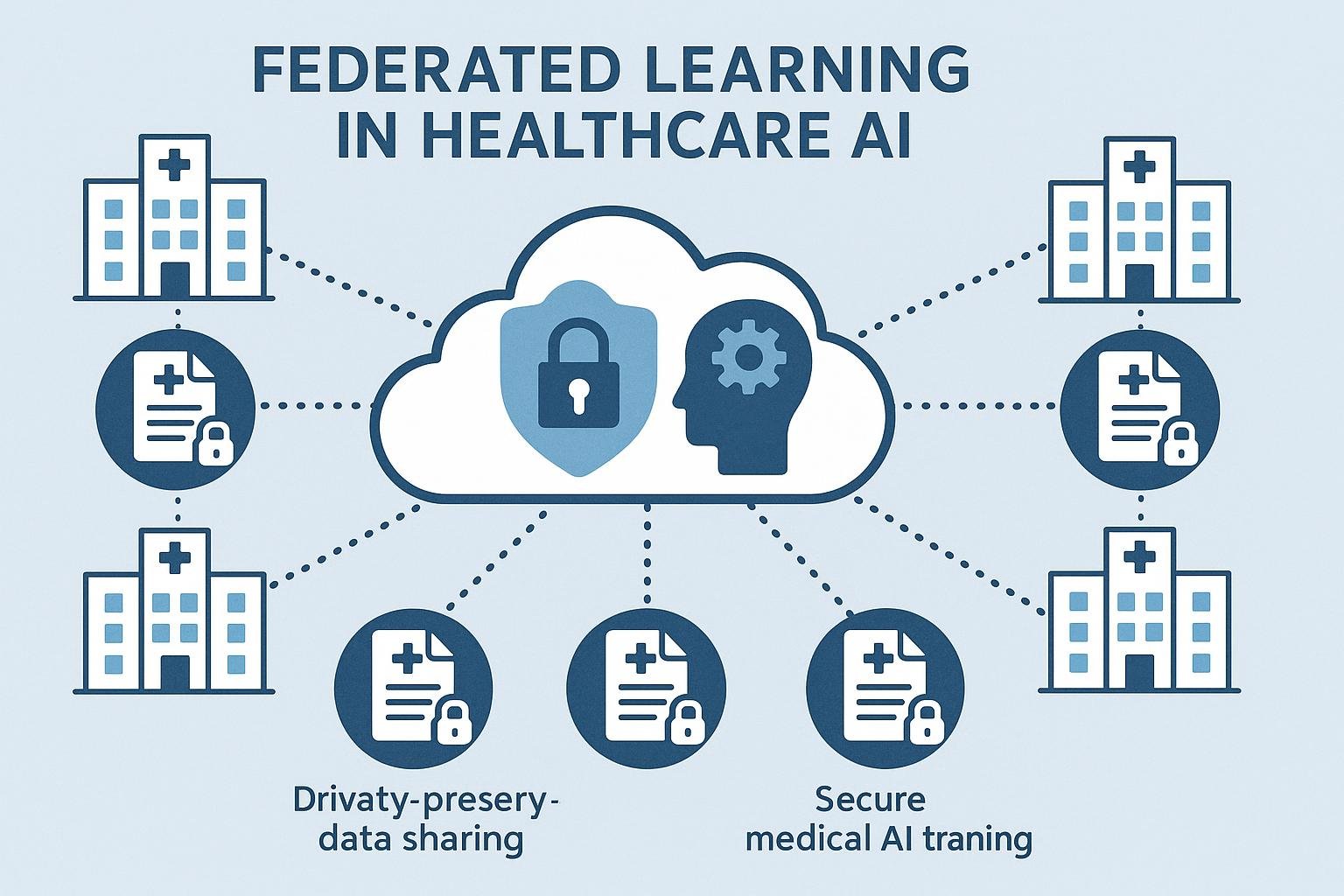
Federated learning represents a fundamental shift in how we think about AI training and data privacy. Instead of the traditional approach of centralizing data for AI training, federated learning distributes the training process across multiple sites while keeping data local and private.
The Traditional AI Training Paradigm
To understand the revolutionary nature of federated learning, it’s important to first understand how traditional AI training works:
Data Centralization: Organizations collect data from multiple sources and centralize it in a single location for AI training.
Privacy Risks: Centralizing sensitive data creates significant privacy risks, regulatory compliance challenges, and potential security vulnerabilities.
Data Sharing Barriers: Organizations are often reluctant to share sensitive data, limiting the potential for collaborative AI development.
Regulatory Constraints: Healthcare regulations like HIPAA make it difficult or impossible to share patient data for AI training purposes.
The Federated Learning Revolution
Federated learning turns this paradigm on its head:
Distributed Training: AI models are trained across multiple sites without centralizing data.
Local Data Privacy: Sensitive data never leaves its original location, maintaining privacy and security.
Collaborative Learning: Organizations can collaborate on AI development without sharing sensitive information.
Regulatory Compliance: The approach aligns with privacy regulations and healthcare compliance requirements.
How Federated Learning Works: A Technical Overview
“`
Federated Learning Process:
- Model Initialization
- Central coordinator creates initial AI model
- Model architecture and parameters are distributed to participating sites
- Each site receives identical starting model
- Local Training
- Each site trains the model using their local data
- Training occurs entirely within each organization’s secure environment
- No patient data leaves the local site
- Model Update Aggregation
- Sites share only model updates (gradients/parameters), not data
- Central coordinator aggregates updates from all participating sites
- Advanced cryptographic techniques protect update privacy
- Global Model Update
- Aggregated updates are used to improve the global model
- Updated global model is distributed back to all sites
- Process repeats iteratively to improve model performance
- Deployment
- Final trained model is deployed at each participating site
- Each organization benefits from collaborative learning
- Patient data remains private throughout the entire process
“`
The Healthcare Privacy Imperative
Healthcare organizations face unique privacy challenges that make federated learning particularly valuable:
Regulatory Compliance Requirements
HIPAA Compliance: Traditional data sharing for AI training often violates HIPAA requirements, while federated learning enables compliance by keeping PHI local.
State Privacy Laws: Emerging state privacy regulations create additional constraints on healthcare data sharing that federated learning can help address.
International Regulations: Organizations operating internationally must comply with GDPR and other privacy regulations that federated learning naturally supports.
Patient Trust and Ethical Considerations
Patient Expectations: Patients expect their healthcare data to remain private and secure, expectations that federated learning helps fulfill.
Ethical AI Development: Federated learning enables ethical AI development that respects patient privacy while advancing medical knowledge.
Transparency and Consent: Organizations can be more transparent with patients about AI development when data remains local and private.
Competitive and Strategic Considerations
Competitive Advantage: Organizations can participate in collaborative AI development without revealing proprietary data or losing competitive advantages.
Risk Mitigation: Federated learning reduces the risks associated with data breaches and privacy violations.
Innovation Enablement: The approach enables innovation that would otherwise be impossible due to privacy constraints.
Real-World Federated Learning Success Stories
Several healthcare organizations have successfully implemented federated learning for ambient clinical AI systems, demonstrating the practical viability and benefits of the approach.
Case Study 1: The Emergency Medicine Consortium
Challenge: A consortium of 15 emergency departments wanted to improve their ambient clinical AI systems for triage and documentation, but couldn’t share patient data due to privacy and competitive concerns.
Solution: The consortium implemented a federated learning approach that allowed each hospital to contribute to AI model improvement without sharing patient conversations or clinical notes.
Implementation Process:
Phase 1: Infrastructure Setup (Months 1-2)
- Each hospital deployed federated learning infrastructure
- Secure communication channels were established between sites
- Privacy-preserving aggregation protocols were implemented
Phase 2: Model Development (Months 3-6)
- Initial ambient AI model was distributed to all participating sites
- Each site trained the model using their local patient encounter data
- Model updates were aggregated using secure multi-party computation
Phase 3: Validation and Deployment (Months 7-8)
- Federated model performance was validated against local benchmarks
- Final model was deployed across all participating hospitals
- Continuous federated learning was established for ongoing improvement
Results:
- 28% improvement in clinical note accuracy across all participating sites
- 15% reduction in documentation time for emergency physicians
- Zero patient privacy violations or data sharing incidents
- 100% regulatory compliance maintained throughout the process
Key Success Factors:
- Strong governance framework with clear privacy protections
- Technical infrastructure that prioritized security and privacy
- Physician engagement and training on federated learning benefits
- Continuous monitoring and validation of model performance
Case Study 2: The Rural Health Network
Challenge: A network of 25 rural hospitals wanted to improve their ambient clinical AI capabilities but lacked the data volume needed for effective AI training at individual sites.
Solution: Federated learning enabled the rural hospitals to pool their collective AI training power without centralizing sensitive patient data.
Unique Implementation Considerations:
Bandwidth Constraints: Rural hospitals often have limited internet bandwidth, requiring optimized federated learning protocols that minimize data transmission.
Technical Expertise: Limited IT resources at rural sites required simplified deployment and management tools.
Regulatory Complexity: Rural hospitals often serve patients from multiple states, creating complex regulatory compliance requirements.
Implementation Approach:
“`
Rural Federated Learning Architecture:
- Lightweight Client Deployment
- Minimal hardware requirements for rural sites
- Automated deployment and configuration tools
- Remote monitoring and management capabilities
- Bandwidth-Optimized Protocols
- Compressed model update transmission
- Asynchronous communication protocols
- Adaptive scheduling based on network availability
- Simplified Management Interface
- User-friendly dashboards for non-technical staff
- Automated troubleshooting and error resolution
- Remote technical support and maintenance
- Regulatory Compliance Automation
- Automated compliance monitoring and reporting
- Built-in privacy protection mechanisms
- Simplified audit and documentation processes
“`
Results:
- 35% improvement in diagnostic accuracy for common conditions
- 40% reduction in clinical documentation time
- Successful deployment across all 25 rural hospitals
- Zero technical support incidents requiring on-site intervention
- Full regulatory compliance maintained across multiple jurisdictions
Technical Implementation Guide for Healthcare Organizations
Implementing federated learning for ambient clinical AI requires careful planning and execution. Here’s a comprehensive guide for healthcare organizations considering this approach.
Phase 1: Assessment and Planning (Weeks 1-4)
#### Organizational Readiness Assessment
Technical Infrastructure Evaluation:
- Network bandwidth and connectivity assessment
- Computing resource availability and requirements
- Data storage and management capabilities
- Cybersecurity infrastructure and controls
Regulatory and Legal Review:
- HIPAA compliance requirements and constraints
- State and federal privacy law considerations
- Institutional Review Board (IRB) requirements for research
- Legal agreements and data use restrictions
Stakeholder Engagement:
- Clinical leadership buy-in and support
- IT department capacity and expertise
- Privacy and compliance team involvement
- Patient advocacy and ethics committee input
#### Use Case Definition and Scope
Clinical Objectives:
- Specific AI capabilities to be improved through federated learning
- Target patient populations and clinical scenarios
- Success metrics and performance benchmarks
- Timeline and milestone definitions
Technical Requirements:
- AI model architecture and training requirements
- Data volume and quality specifications
- Privacy and security protection levels
- Integration requirements with existing systems
Phase 2: Technical Architecture Design (Weeks 5-8)
#### Federated Learning Architecture Components
Central Coordination Server:
“`
Coordination Server Specifications:
- Secure model aggregation and distribution
- Participant authentication and authorization
- Communication protocol management
- Performance monitoring and analytics
- Audit logging and compliance reporting
“`
Local Training Nodes:
“`
Local Node Requirements:
- Secure model training environment
- Local data access and processing capabilities
- Encrypted communication with coordination server
- Privacy-preserving update generation
- Local monitoring and error handling
“`
Privacy Protection Mechanisms:
“`
Privacy Protection Framework:
- Differential privacy for model updates
- Secure multi-party computation for aggregation
- Homomorphic encryption for sensitive computations
- Zero-knowledge proofs for verification
- Secure communication protocols (TLS 1.3+)
“`
#### Security and Privacy Controls
Access Control and Authentication:
- Multi-factor authentication for all participants
- Role-based access control for federated learning functions
- Certificate-based authentication for automated systems
- Regular access review and audit procedures
Data Protection and Encryption:
- End-to-end encryption for all communications
- Local data encryption at rest and in transit
- Secure key management and rotation
- Privacy-preserving computation techniques
Monitoring and Auditing:
- Comprehensive audit logging of all federated learning activities
- Real-time monitoring of system performance and security
- Automated anomaly detection and alerting
- Regular security assessments and penetration testing
Phase 3: Implementation and Testing (Weeks 9-16)
#### Pilot Implementation
Small-Scale Deployment:
- Start with 2-3 participating sites for initial testing
- Use synthetic or de-identified data for initial validation
- Implement comprehensive monitoring and logging
- Conduct thorough security and privacy testing
Performance Validation:
- Compare federated learning results with traditional centralized training
- Validate model accuracy and performance metrics
- Test privacy protection mechanisms and controls
- Verify regulatory compliance and audit requirements
#### Gradual Rollout Strategy
Phased Expansion:
“`
Rollout Timeline:
Week 9-12: Pilot with 2-3 sites
Week 13-14: Expand to 5-7 sites
Week 15-16: Full deployment to all participating sites
Week 17+: Continuous monitoring and optimization
“`
Risk Mitigation:
- Implement rollback procedures for each phase
- Maintain parallel traditional systems during transition
- Conduct regular security and privacy assessments
- Establish incident response procedures for federated learning events
Phase 4: Production Deployment and Optimization (Weeks 17+)
#### Production Operations
Continuous Monitoring:
- Real-time performance monitoring and alerting
- Privacy protection verification and validation
- Regulatory compliance monitoring and reporting
- Participant engagement and satisfaction tracking
Ongoing Optimization:
- Model performance tuning and improvement
- Privacy protection enhancement and updates
- System performance optimization and scaling
- Participant feedback integration and response
Advanced Federated Learning Techniques for Healthcare
Beyond basic federated learning, several advanced techniques can provide additional benefits for healthcare organizations:
Differential Privacy in Federated Learning
Enhanced Privacy Protection: Combining federated learning with differential privacy provides mathematical guarantees of privacy protection.
Implementation Approach:
“`
Differential Privacy Integration:
- Add calibrated noise to model updates before sharing
- Implement privacy budget management across training rounds
- Use formal privacy accounting methods
- Balance privacy protection with model utility
“`
Healthcare Benefits:
- Formal privacy guarantees that exceed regulatory requirements
- Protection against sophisticated inference attacks
- Enhanced patient trust and confidence
- Reduced legal and regulatory risks
Secure Multi-Party Computation (SMPC)
Advanced Cryptographic Protection: SMPC enables federated learning participants to jointly compute model updates without revealing individual contributions.
Technical Implementation:
“`
SMPC Protocol Integration:
- Implement secret sharing for model parameters
- Use secure aggregation protocols for update combination
- Deploy threshold cryptography for distributed key management
- Integrate zero-knowledge proofs for verification
“`
Organizational Benefits:
- Protection against malicious participants
- Enhanced security for competitive environments
- Compliance with strict privacy regulations
- Reduced trust requirements between participants
Federated Learning with Homomorphic Encryption
Computation on Encrypted Data: Homomorphic encryption enables federated learning computations on encrypted model updates.
Implementation Considerations:
- Significant computational overhead requiring powerful hardware
- Limited to specific types of mathematical operations
- Requires specialized expertise for implementation and management
- Provides the highest level of privacy protection available
Overcoming Common Implementation Challenges
Healthcare organizations implementing federated learning often encounter specific challenges that require careful planning and mitigation:
Challenge 1: Technical Complexity and Expertise
Problem: Federated learning requires specialized technical expertise that many healthcare organizations lack.
Solutions:
- Partner with experienced federated learning vendors and consultants
- Invest in training and education for internal IT teams
- Start with simplified implementations and gradually increase complexity
- Participate in industry consortiums and knowledge-sharing initiatives
Challenge 2: Regulatory and Legal Uncertainty
Problem: Regulatory guidance for federated learning in healthcare is still evolving.
Solutions:
- Engage proactively with regulatory bodies and legal experts
- Implement conservative privacy protections that exceed current requirements
- Participate in industry efforts to develop regulatory guidance
- Maintain detailed documentation of privacy protection measures
Challenge 3: Organizational Coordination and Governance
Problem: Federated learning requires coordination between multiple organizations with different priorities and constraints.
Solutions:
- Establish clear governance frameworks and decision-making processes
- Develop comprehensive legal agreements and data use policies
- Implement regular communication and coordination mechanisms
- Create shared incentives and benefits for all participants
Challenge 4: Performance and Scalability
Problem: Federated learning can be slower and more complex than traditional centralized training.
Solutions:
- Optimize communication protocols and model update compression
- Implement asynchronous training and flexible scheduling
- Use advanced aggregation algorithms that handle heterogeneous data
- Invest in appropriate hardware and network infrastructure
Measuring Success: KPIs for Federated Learning Implementation
Successful federated learning implementations require comprehensive measurement and monitoring:
Technical Performance Metrics
Model Accuracy and Performance:
- Comparison of federated vs. centralized model performance
- Convergence time and training efficiency
- Model robustness and generalization capabilities
- Resource utilization and computational efficiency
System Reliability and Availability:
- Uptime and availability of federated learning infrastructure
- Communication reliability between participating sites
- Error rates and failure recovery times
- Scalability and performance under load
Privacy and Security Metrics
Privacy Protection Effectiveness:
- Privacy budget utilization and management
- Inference attack resistance testing results
- Data leakage detection and prevention
- Compliance audit results and findings
Security Control Effectiveness:
- Security incident frequency and severity
- Vulnerability assessment and penetration testing results
- Access control compliance and effectiveness
- Encryption and communication security validation
Organizational and Business Metrics
Participant Satisfaction and Engagement:
- Participant retention and continued engagement
- Satisfaction surveys and feedback scores
- Time to value and benefit realization
- Cost-benefit analysis and ROI measurement
Regulatory and Compliance Metrics:
- Compliance audit results and findings
- Regulatory inquiry and enforcement actions
- Patient complaint and privacy violation rates
- Legal and regulatory cost avoidance
The Future of Federated Learning in Healthcare
Federated learning is rapidly evolving, with new techniques and applications emerging regularly:
Emerging Trends and Technologies
Cross-Modal Federated Learning: Combining different types of healthcare data (text, images, audio) in federated learning environments.
Federated Transfer Learning: Using pre-trained models in federated learning to improve efficiency and performance.
Blockchain-Based Federated Learning: Using blockchain technology to enhance trust and transparency in federated learning networks.
Edge Computing Integration: Deploying federated learning on edge devices to reduce latency and improve privacy.
Industry Initiatives and Standards
Healthcare Federated Learning Consortiums: Industry groups working to develop standards and best practices for healthcare federated learning.
Regulatory Guidance Development: Ongoing efforts to develop clear regulatory guidance for federated learning in healthcare.
Open Source Frameworks: Development of open source tools and frameworks to simplify federated learning implementation.
Interoperability Standards: Creation of standards to enable federated learning across different platforms and vendors.
Building Your Federated Learning Strategy
Healthcare organizations considering federated learning should develop a comprehensive strategy that addresses technical, regulatory, and organizational considerations:
Strategic Planning Framework
Vision and Objectives:
- Define clear goals and success criteria for federated learning implementation
- Align federated learning strategy with organizational privacy and innovation objectives
- Establish timeline and resource requirements for implementation
- Identify key stakeholders and decision-makers
Risk Assessment and Mitigation:
- Conduct comprehensive risk assessment of federated learning implementation
- Develop mitigation strategies for identified risks and challenges
- Establish contingency plans for potential implementation issues
- Create monitoring and response procedures for ongoing risk management
Implementation Roadmap
Short-Term Actions (0-6 months):
- Conduct organizational readiness assessment
- Engage with federated learning vendors and consultants
- Develop pilot implementation plan and timeline
- Establish governance framework and legal agreements
Medium-Term Actions (6-18 months):
- Implement pilot federated learning deployment
- Validate technical performance and privacy protection
- Expand implementation to additional use cases and participants
- Develop operational procedures and support capabilities
Long-Term Actions (18+ months):
- Scale federated learning across the organization
- Integrate with broader AI and analytics strategy
- Participate in industry initiatives and standards development
- Continuously optimize and improve federated learning capabilities
Take Action: Implement Privacy-Preserving AI with Federated Learning
Federated learning represents a transformative opportunity to advance healthcare AI while maintaining the highest standards of patient privacy protection. Don’t let privacy concerns prevent you from realizing the benefits of collaborative AI development.
Download our Federated Learning Implementation Guide to get started with practical tools and templates:
- Technical architecture templates and specifications
- Regulatory compliance checklists and procedures
- Vendor evaluation criteria and selection guides
- Implementation project plans and timelines
- Privacy protection validation and testing procedures
[Download the Federated Learning Implementation Guide →]()
Ready to explore federated learning for your organization? Our team of federated learning specialists can help you assess your readiness and develop a customized implementation strategy.
[Schedule Your Federated Learning Consultation →]()
Join the healthcare federated learning community to connect with other organizations implementing privacy-preserving AI and share best practices and lessons learned.
[Join the Federated Learning Community →]()
*This is Part 5 of our 12-part series on securing ambient clinical note AI systems. In our next article, we’ll explore differential privacy and how it provides mathematical guarantees of privacy protection while enabling powerful AI capabilities.*
Coming Next Week: “Differential Privacy in Healthcare AI: Balancing Utility and Patient Protection”
About EncryptCentral: We are the leading cybersecurity consulting firm specializing in healthcare AI security and privacy-preserving technologies. Our team includes federated learning experts, privacy engineers, and healthcare AI specialists who can help you implement cutting-edge privacy protection while advancing your AI capabilities.
*Interested in implementing federated learning for your ambient clinical AI systems? Our expert team can guide you through every step of the process, from initial assessment to full production deployment.*
Ready to Secure Your Healthcare AI Systems?
Get our comprehensive Healthcare AI Security Assessment Toolkit—a $5,000 value, absolutely free. This toolkit includes:
- ✓ 23-Point AI Security Risk Assessment Checklist
- ✓ HIPAA Compliance Framework for AI Systems
- ✓ Incident Response Playbook for AI Security Events
- ✓ ROI Calculator for AI Security Investments