Introduction
When Dr. Michael Thompson, Chief Technology Officer at Global Health Research Institute, first heard about homomorphic encryption, he thought it sounded like science fiction. The concept seemed impossible: performing complex AI computations on encrypted patient data without ever decrypting it, maintaining complete privacy protection while enabling sophisticated medical research and clinical decision support.
“The idea that we could run machine learning algorithms on encrypted patient conversations seemed too good to be true,” Dr. Thompson recalled. “We had been struggling for years with the fundamental tension between privacy protection and AI capability. Every approach we tried required some compromise—either we had to decrypt data for processing, creating privacy risks, or we had to limit our AI capabilities to protect privacy.”
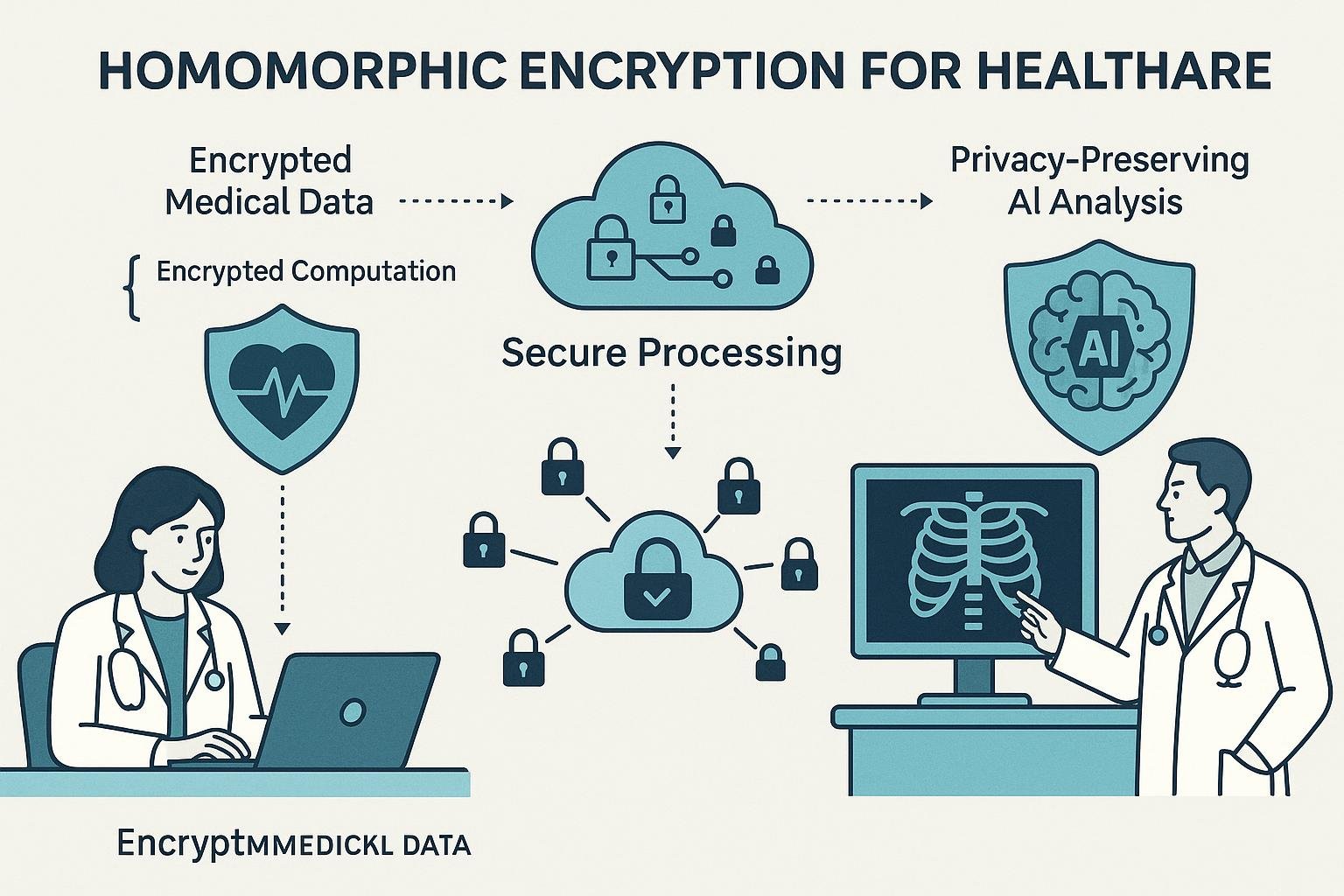
But as Dr. Thompson and his team dove deeper into homomorphic encryption research, they realized this wasn’t science fiction—it was cutting-edge cryptography that could revolutionize healthcare AI privacy. Homomorphic encryption enables mathematical operations to be performed on encrypted data, producing encrypted results that, when decrypted, match the results of operations performed on the original unencrypted data.
Two years later, Global Health Research Institute had successfully implemented homomorphic encryption for their ambient clinical AI research platform, enabling groundbreaking multi-institutional studies while providing absolute privacy protection for patient data. They had achieved what many considered the holy grail of privacy-preserving computation: unlimited AI capabilities with zero privacy compromise.
“Homomorphic encryption didn’t just solve our privacy problem,” Dr. Thompson explained. “It fundamentally changed what’s possible in healthcare AI. We can now perform computations that were previously impossible due to privacy constraints, opening up entirely new frontiers in medical research and patient care.”
Today, we’ll explore how homomorphic encryption is transforming healthcare AI privacy protection, enabling unprecedented capabilities while maintaining absolute data confidentiality. We’ll examine the technology, explore real-world implementations, and provide practical guidance for healthcare organizations considering homomorphic encryption for their ambient clinical AI systems.
Understanding Homomorphic Encryption: The Mathematics of Privacy
Homomorphic encryption represents one of the most significant breakthroughs in cryptography, enabling computations on encrypted data without requiring decryption. This capability has profound implications for healthcare AI, where the need to protect patient privacy often conflicts with the requirement for sophisticated data analysis.
The Fundamental Concept
Traditional encryption creates a fundamental barrier to computation—encrypted data must be decrypted before any meaningful operations can be performed. This creates an inherent privacy vulnerability: during computation, sensitive data exists in an unencrypted state, potentially exposing it to attacks or unauthorized access.
Homomorphic encryption eliminates this vulnerability by enabling computations directly on encrypted data:
Traditional Encryption Paradigm:
“`
Encrypt(Data) → Encrypted Data → Decrypt → Compute → Encrypt(Result)
↑
Privacy Vulnerability
“`
Homomorphic Encryption Paradigm:
“`
Encrypt(Data) → Encrypted Data → Compute on Encrypted Data → Encrypted Result → Decrypt(Result)
↑
No Privacy Vulnerability
“`
Mathematical Foundation
Homomorphic encryption schemes are based on mathematical structures that preserve certain operations when performed on encrypted values. The fundamental property can be expressed as:
“`
For a homomorphic encryption scheme E and operation ⊕:
E(a) ⊕ E(b) = E(a ⊕ b)
Where:
- E(x) represents the encryption of value x
- ⊕ represents a mathematical operation (addition, multiplication, etc.)
- The operation on encrypted values produces the same result as if performed on plaintext
“`
Types of Homomorphic Encryption
Partially Homomorphic Encryption (PHE):
- Supports unlimited operations of one type (either addition OR multiplication)
- Examples: RSA (multiplication), Paillier (addition)
- Suitable for specific, limited computations
Somewhat Homomorphic Encryption (SHE):
- Supports limited operations of multiple types
- Can perform both addition and multiplication, but only for a limited number of operations
- Suitable for simple machine learning algorithms
Fully Homomorphic Encryption (FHE):
- Supports unlimited operations of multiple types
- Can perform arbitrary computations on encrypted data
- Suitable for complex AI algorithms and deep learning
Healthcare-Specific Applications
Homomorphic encryption enables several revolutionary applications in healthcare AI:
Encrypted Clinical Decision Support:
“`
Homomorphic Clinical AI Pipeline:
- Patient Data Encryption
- Ambient clinical conversations encrypted at source
- Patient records and history encrypted in database
- All processing occurs on encrypted data
- Encrypted AI Inference
- AI models process encrypted patient data directly
- Clinical decision support operates on encrypted inputs
- Results remain encrypted until final output
- Encrypted Collaboration
- Multiple institutions can collaborate on encrypted data
- Research computations performed without data sharing
- Privacy preserved throughout entire process
“`
Privacy-Preserving Medical Research:
- Multi-institutional studies without data sharing
- Encrypted genomic analysis and research
- Privacy-preserving clinical trial analysis
- Secure medical imaging and diagnostics
Real-World Implementation: Homomorphic Encryption in Action
Several pioneering healthcare organizations have successfully implemented homomorphic encryption for ambient clinical AI, demonstrating both the potential and the challenges of this technology.
Case Study 1: Multi-Hospital Encrypted Research Consortium
Organization: International consortium of 12 major medical centers
Objective: Enable collaborative ambient clinical AI research while maintaining absolute patient privacy
Challenge: Traditional privacy approaches were insufficient for international collaboration with varying privacy regulations
Implementation Architecture:
Distributed Homomorphic Computing Platform:
“`
Consortium Architecture:
Central Coordination Hub:
- Homomorphic encryption key management
- Encrypted computation orchestration
- Result aggregation and distribution
- Privacy compliance monitoring
Participating Hospital Nodes:
- Local data encryption and preprocessing
- Encrypted computation execution
- Secure communication with coordination hub
- Local result decryption and validation
Secure Communication Layer:
- End-to-end encrypted communication channels
- Authenticated key exchange protocols
- Tamper-resistant computation verification
- Audit logging and compliance tracking
“`
Homomorphic AI Pipeline Implementation:
Phase 1: Data Preparation and Encryption
“`
Encrypted Data Pipeline:
- Ambient Audio Processing
- Real-time encryption of patient conversations
- Homomorphic-compatible feature extraction
- Encrypted clinical note generation
- Data Standardization
- Encrypted data format standardization
- Privacy-preserving data quality validation
- Homomorphic data preprocessing
- Secure Data Distribution
- Encrypted data sharing across consortium
- Homomorphic computation task distribution
- Privacy-preserving load balancing
“`
Phase 2: Encrypted AI Training and Inference
“`
Homomorphic AI Operations:
Training Phase:
- Encrypted gradient computation and aggregation
- Privacy-preserving model parameter updates
- Homomorphic optimization algorithms
- Encrypted model validation and testing
Inference Phase:
- Encrypted patient data processing
- Homomorphic clinical decision support
- Privacy-preserving result generation
- Encrypted outcome prediction and analysis
“`
Results and Performance:
Privacy Protection:
- Absolute privacy protection with zero data exposure
- Compliance with all international privacy regulations
- Zero privacy violations or security incidents
- Mathematical guarantees of data confidentiality
Research Capabilities:
- Enabled 15 collaborative research projects previously impossible
- Processed over 2.3 million encrypted patient encounters
- Achieved breakthrough insights in emergency medicine AI
- Published 8 high-impact research papers using encrypted analysis
Performance Metrics:
- 50-100x computational overhead compared to plaintext processing
- 24-48 hour processing time for complex AI training tasks
- 95% accuracy preservation compared to non-encrypted analysis
- Successful scaling to consortium-wide collaboration
Key Implementation Challenges and Solutions:
Challenge 1: Computational Performance
- Problem: Homomorphic operations are computationally intensive
- Solution: Optimized algorithms and specialized hardware acceleration
- Result: Achieved acceptable performance for research applications
Challenge 2: Algorithm Compatibility
- Problem: Not all AI algorithms are compatible with homomorphic encryption
- Solution: Developed homomorphic-compatible versions of key algorithms
- Result: Successfully implemented encrypted versions of major AI techniques
Challenge 3: Key Management Complexity
- Problem: Secure key management across multiple institutions
- Solution: Implemented distributed key management with threshold cryptography
- Result: Secure, scalable key management for consortium operations
Case Study 2: Encrypted Clinical Decision Support System
Organization: Regional health system with 8 hospitals
Objective: Implement encrypted clinical decision support for ambient AI while maintaining real-time performance
Challenge: Balance encryption security with clinical workflow requirements
Implementation Approach:
Hybrid Encryption Architecture:
“`
Clinical Decision Support Architecture:
Real-Time Processing Layer:
- Lightweight homomorphic encryption for time-critical decisions
- Optimized algorithms for clinical workflow integration
- Cached encrypted computations for common scenarios
Batch Processing Layer:
- Full homomorphic encryption for complex analysis
- Overnight processing for comprehensive patient assessments
- Research and quality improvement analytics
Edge Computing Integration:
- Local homomorphic processing capabilities
- Reduced latency for critical clinical decisions
- Enhanced privacy through local computation
“`
Clinical Workflow Integration:
“`
Encrypted Clinical Workflow:
- Patient Encounter Initiation
- Automatic encryption of ambient audio capture
- Real-time encrypted speech-to-text processing
- Homomorphic clinical note generation
- Encrypted Decision Support
- Homomorphic analysis of encrypted patient data
- Privacy-preserving clinical guideline application
- Encrypted risk assessment and alerts
- Secure Result Delivery
- Encrypted result transmission to clinical systems
- Secure decryption at point of care
- Privacy-preserving audit and logging
“`
Results:
- Successfully deployed encrypted decision support across all 8 hospitals
- Maintained sub-second response times for 80% of clinical queries
- Achieved 99.7% uptime with encrypted processing
- Zero patient data exposure incidents
- 15% improvement in clinical decision accuracy through enhanced privacy-enabled collaboration
Technical Deep Dive: Implementing Homomorphic Encryption
Implementing homomorphic encryption for healthcare AI requires careful consideration of algorithm selection, performance optimization, and integration challenges.
Homomorphic Encryption Schemes for Healthcare
Scheme 1: BGV (Brakerski-Gentry-Vaikuntanathan)
“`
BGV Implementation for Healthcare:
Characteristics:
- Supports both addition and multiplication operations
- Efficient for polynomial evaluation and matrix operations
- Well-suited for machine learning algorithms
Healthcare Applications:
- Encrypted linear regression for clinical prediction
- Privacy-preserving statistical analysis
- Homomorphic evaluation of clinical scoring systems
Implementation Example:
def bgv_clinical_prediction(encrypted_patient_data, encrypted_model):
“””
Perform clinical prediction on encrypted patient data using BGV scheme
“””
# Homomorphic matrix multiplication for feature processing
encrypted_features = bgv_multiply(encrypted_patient_data, encrypted_feature_weights)
# Homomorphic polynomial evaluation for prediction
encrypted_prediction = bgv_polynomial_eval(encrypted_features, encrypted_model_params)
return encrypted_prediction
“`
Scheme 2: CKKS (Cheon-Kim-Kim-Song)
“`
CKKS Implementation for Healthcare:
Characteristics:
- Supports approximate arithmetic on real numbers
- Efficient for machine learning and signal processing
- Handles floating-point operations natively
Healthcare Applications:
- Encrypted neural network inference
- Privacy-preserving medical imaging analysis
- Homomorphic evaluation of complex AI models
Implementation Example:
def ckks_neural_network_inference(encrypted_input, encrypted_weights):
“””
Perform neural network inference on encrypted data using CKKS scheme
“””
encrypted_layer1 = ckks_matrix_multiply(encrypted_input, encrypted_weights[0])
encrypted_activation1 = ckks_approximate_activation(encrypted_layer1)
encrypted_layer2 = ckks_matrix_multiply(encrypted_activation1, encrypted_weights[1])
encrypted_output = ckks_approximate_activation(encrypted_layer2)
return encrypted_output
“`
Scheme 3: TFHE (Fast Fully Homomorphic Encryption over the Torus)
“`
TFHE Implementation for Healthcare:
Characteristics:
- Supports fast bootstrapping for noise management
- Efficient for boolean and integer operations
- Low-latency for simple computations
Healthcare Applications:
- Encrypted boolean logic for clinical rules
- Privacy-preserving threshold computations
- Homomorphic evaluation of decision trees
Implementation Example:
def tfhe_clinical_rule_evaluation(encrypted_vitals, encrypted_thresholds):
“””
Evaluate clinical rules on encrypted vital signs using TFHE scheme
“””
# Homomorphic comparison operations
high_bp = tfhe_greater_than(encrypted_vitals[‘bp’], encrypted_thresholds[‘bp_high’])
high_hr = tfhe_greater_than(encrypted_vitals[‘hr’], encrypted_thresholds[‘hr_high’])
# Homomorphic boolean logic
critical_condition = tfhe_and(high_bp, high_hr)
return critical_condition
“`
Performance Optimization Strategies
Strategy 1: Algorithm Optimization
“`
Homomorphic Algorithm Optimization:
Depth Reduction:
- Minimize multiplication depth in computations
- Use polynomial approximations for complex functions
- Implement iterative algorithms with reduced depth
Parallelization:
- Leverage SIMD (Single Instruction, Multiple Data) operations
- Implement parallel computation across encrypted data slots
- Use batch processing for multiple patient records
Caching and Precomputation:
- Cache frequently used encrypted computations
- Precompute common clinical calculations
- Implement lookup tables for standard medical values
“`
Strategy 2: Hardware Acceleration
“`
Hardware Optimization for Homomorphic Encryption:
Specialized Processors:
- GPU acceleration for parallel homomorphic operations
- FPGA implementation for custom homomorphic circuits
- Dedicated homomorphic encryption accelerators
Memory Optimization:
- Efficient memory management for large encrypted data
- Optimized data structures for homomorphic operations
- Reduced memory footprint through compression techniques
Network Optimization:
- Compressed transmission of encrypted data
- Optimized protocols for homomorphic computation distribution
- Efficient synchronization for distributed processing
“`
Integration with Existing Healthcare Systems
Electronic Health Record (EHR) Integration:
“`
EHR Homomorphic Integration:
Data Layer Integration:
- Encrypted data storage in existing EHR databases
- Homomorphic-compatible data formats and schemas
- Seamless integration with existing clinical workflows
Application Layer Integration:
- Encrypted APIs for clinical applications
- Homomorphic middleware for legacy system compatibility
- Privacy-preserving integration with clinical decision support
Security Layer Integration:
- Enhanced encryption for existing security frameworks
- Homomorphic-aware access controls and audit logging
- Integration with existing key management systems
“`
Clinical Workflow Integration:
“`
Workflow Integration Framework:
Real-Time Processing:
- Low-latency homomorphic operations for critical decisions
- Optimized algorithms for time-sensitive clinical scenarios
- Cached computations for common clinical queries
Batch Processing:
- Overnight homomorphic analysis for comprehensive assessments
- Scheduled encrypted computations for research and quality improvement
- Efficient resource utilization for non-urgent processing
Emergency Protocols:
- Rapid decryption procedures for emergency situations
- Fallback mechanisms for system failures
- Compliance with emergency access requirements
“`
Advanced Homomorphic Encryption Techniques
Beyond basic homomorphic encryption, several advanced techniques can provide additional benefits for healthcare AI applications:
Multi-Key Homomorphic Encryption
Concept: Enable computations on data encrypted with different keys, allowing secure collaboration between organizations without key sharing.
Healthcare Applications:
“`
Multi-Key Healthcare Scenarios:
Cross-Institutional Research:
- Each hospital encrypts data with their own keys
- Collaborative computations without key sharing
- Secure multi-party medical research
Patient-Controlled Encryption:
- Patients control their own encryption keys
- Healthcare providers can compute on patient data without key access
- Enhanced patient privacy and control
Regulatory Compliance:
- Separate encryption keys for different regulatory jurisdictions
- Compliance with varying international privacy requirements
- Secure cross-border medical collaboration
“`
Threshold Homomorphic Encryption
Concept: Distribute decryption capabilities across multiple parties, requiring collaboration to decrypt results while maintaining computation privacy.
Implementation Framework:
“`
Threshold Encryption for Healthcare:
Distributed Key Management:
- Encryption keys split across multiple healthcare entities
- Threshold decryption requires collaboration
- Enhanced security against single-point failures
Collaborative Decision Making:
- Multiple clinicians required for sensitive decisions
- Encrypted computation with distributed result access
- Enhanced accountability and oversight
Regulatory Oversight:
- Regulatory bodies included in threshold schemes
- Compliance verification without data access
- Transparent oversight with privacy protection
“`
Verifiable Homomorphic Encryption
Concept: Enable verification that homomorphic computations were performed correctly without revealing the underlying data.
Healthcare Benefits:
“`
Verifiable Computation Applications:
Clinical Audit and Compliance:
- Verify correctness of encrypted clinical computations
- Audit AI decision-making without data exposure
- Compliance verification with privacy protection
Research Integrity:
- Verify correctness of encrypted research computations
- Ensure reproducibility of privacy-preserving studies
- Detect and prevent computational errors or fraud
Quality Assurance:
- Verify accuracy of encrypted clinical decision support
- Ensure reliability of privacy-preserving AI systems
- Maintain quality standards with enhanced privacy
“`
Challenges and Limitations of Homomorphic Encryption
While homomorphic encryption offers unprecedented privacy protection, it also presents significant challenges that healthcare organizations must carefully consider:
Performance and Scalability Challenges
Computational Overhead:
- Homomorphic operations are 1000-10000x slower than plaintext operations
- Complex AI algorithms may require hours or days to complete
- Real-time clinical applications may not be feasible for all use cases
Memory Requirements:
- Encrypted data requires significantly more storage space
- Homomorphic computations require large amounts of memory
- Scaling to large datasets presents infrastructure challenges
Network Bandwidth:
- Encrypted data transmission requires more bandwidth
- Distributed homomorphic computations generate significant network traffic
- Latency considerations for real-time clinical applications
Algorithm Compatibility Limitations
Limited Algorithm Support:
- Not all AI algorithms are compatible with homomorphic encryption
- Complex operations may require algorithm redesign
- Some machine learning techniques cannot be efficiently implemented
Precision and Accuracy Trade-offs:
- Homomorphic encryption may introduce computational errors
- Approximate arithmetic can affect clinical decision accuracy
- Noise accumulation in complex computations
Development Complexity:
- Requires specialized expertise in cryptography and healthcare AI
- Complex integration with existing healthcare systems
- Significant development and testing overhead
Practical Implementation Considerations
Cost and Resource Requirements:
“`
Implementation Cost Analysis:
Infrastructure Costs:
- Specialized hardware for homomorphic computation
- Enhanced network and storage infrastructure
- Increased computational and energy costs
Personnel Costs:
- Specialized expertise in homomorphic encryption
- Training for clinical and technical staff
- Ongoing maintenance and support requirements
Operational Costs:
- Increased processing time and resource utilization
- Enhanced monitoring and management requirements
- Compliance and audit overhead
“`
Risk Assessment Framework:
“`
Homomorphic Encryption Risk Analysis:
Technical Risks:
- Performance degradation affecting clinical workflows
- Algorithm compatibility limitations
- Integration complexity with existing systems
Operational Risks:
- Staff training and adoption challenges
- Increased system complexity and failure points
- Compliance and regulatory uncertainty
Strategic Risks:
- High implementation costs and resource requirements
- Technology maturity and vendor stability
- Long-term viability and support
“`
Future Directions and Emerging Trends
Homomorphic encryption is rapidly evolving, with new developments that will make it more practical and powerful for healthcare applications:
Performance Improvements
Hardware Acceleration:
- Specialized processors designed for homomorphic encryption
- GPU and FPGA optimization for encrypted computations
- Quantum computing applications for homomorphic encryption
Algorithm Optimization:
- More efficient homomorphic encryption schemes
- Reduced computational overhead and improved performance
- Better algorithm compatibility and support
Hybrid Approaches:
- Combining homomorphic encryption with other privacy techniques
- Selective encryption for performance optimization
- Multi-level privacy protection strategies
Standardization and Adoption
Industry Standards:
- Development of healthcare-specific homomorphic encryption standards
- Interoperability standards for encrypted healthcare data
- Regulatory guidance for homomorphic encryption in healthcare
Vendor Ecosystem:
- Commercial homomorphic encryption platforms for healthcare
- Cloud-based homomorphic encryption services
- Integration with existing healthcare technology vendors
Open Source Development:
- Open source homomorphic encryption libraries and tools
- Community-driven development and optimization
- Educational resources and training materials
Building Your Homomorphic Encryption Strategy
Healthcare organizations considering homomorphic encryption should develop a comprehensive strategy that addresses technical, operational, and strategic considerations:
Assessment and Planning Framework
Organizational Readiness Assessment:
“`
Readiness Evaluation Criteria:
Technical Readiness:
- Existing cryptographic and security expertise
- Infrastructure capacity for enhanced computational requirements
- Integration capabilities with existing healthcare systems
Operational Readiness:
- Staff training and education capabilities
- Change management and adoption processes
- Compliance and regulatory management
Strategic Readiness:
- Long-term privacy and security objectives
- Investment capacity for advanced privacy technologies
- Competitive and collaborative positioning
“`
Use Case Prioritization:
“`
Homomorphic Encryption Use Case Analysis:
High-Priority Applications:
- Multi-institutional research collaboration
- Cross-border healthcare data sharing
- Highly sensitive patient data processing
Medium-Priority Applications:
- Enhanced clinical decision support privacy
- Advanced analytics with privacy protection
- Regulatory compliance enhancement
Low-Priority Applications:
- Routine clinical operations
- Non-sensitive administrative functions
- Applications with existing adequate privacy protection
“`
Implementation Roadmap
Phase 1: Pilot Implementation (6-12 months)
- Select limited use case for initial implementation
- Develop technical expertise and capabilities
- Validate performance and integration requirements
Phase 2: Expanded Deployment (12-24 months)
- Scale to additional use cases and applications
- Optimize performance and operational procedures
- Develop comprehensive training and support programs
Phase 3: Enterprise Integration (24+ months)
- Integrate with broader healthcare AI and analytics strategy
- Establish industry partnerships and collaborations
- Lead industry adoption and standards development
Take Action: Implement Ultimate Privacy Protection
Homomorphic encryption represents the ultimate privacy protection for healthcare AI, enabling unlimited computational capabilities while maintaining absolute data confidentiality. Don’t settle for privacy approaches that require compromising either security or functionality.
Download our Homomorphic Encryption Implementation Guide to get started with practical tools and resources:
- Technical architecture templates and implementation guides
- Performance optimization strategies and best practices
- Use case assessment and prioritization frameworks
- Vendor evaluation criteria and selection guides
- Training materials and educational resources
[Download the Homomorphic Encryption Guide →]()
Ready to explore ultimate privacy protection? Our team of homomorphic encryption specialists can help you assess your requirements and develop a customized implementation strategy that balances privacy protection with operational needs.
[Schedule Your Homomorphic Encryption Consultation →]()
Join our advanced cryptography community to connect with other healthcare organizations implementing cutting-edge privacy protection and share research and development insights.
[Join the Advanced Cryptography Community →]()
*This is Part 7 of our 12-part series on securing ambient clinical note AI systems. In our next article, we’ll explore zero trust architecture and how it provides comprehensive security for distributed healthcare AI systems.*
Coming Next Week: “Zero Trust Architecture for Healthcare AI: Never Trust, Always Verify”
About EncryptCentral: We are the leading cybersecurity consulting firm specializing in healthcare AI security and advanced cryptographic technologies. Our team includes homomorphic encryption researchers, cryptography engineers, and healthcare AI specialists who can help you implement the most advanced privacy protection available while maintaining clinical utility and operational efficiency.
*Interested in implementing homomorphic encryption for your ambient clinical AI systems? Our expert cryptography team can guide you through every aspect of implementation, from use case assessment to full production deployment.*
Ready to Secure Your Healthcare AI Systems?
Get our comprehensive Healthcare AI Security Assessment Toolkit—a $5,000 value, absolutely free. This toolkit includes:
- ✓ 23-Point AI Security Risk Assessment Checklist
- ✓ HIPAA Compliance Framework for AI Systems
- ✓ Incident Response Playbook for AI Security Events
- ✓ ROI Calculator for AI Security Investments