Introduction
When Apple announced in 2016 that they were using differential privacy to protect user data while improving their AI systems, Dr. Sarah Chen, Chief Data Officer at University Medical Center, knew she had found the answer to her most challenging problem. Her organization wanted to use their vast repository of ambient clinical AI data to advance medical research and improve patient care, but traditional privacy protection methods either provided insufficient protection or rendered the data useless for meaningful analysis.
“We had tried everything,” Dr. Chen recalled. “De-identification left us vulnerable to re-identification attacks. Data masking destroyed the clinical relationships we needed for AI training. Synthetic data didn’t capture the complexity of real patient encounters. We needed a solution that could provide mathematical guarantees of privacy protection while preserving the clinical utility of our data.”
Differential privacy offered exactly what Dr. Chen was looking for—a mathematically rigorous approach to privacy protection that could provide formal guarantees that individual patient information could not be extracted from AI systems, even by sophisticated attackers with extensive background knowledge.
Eighteen months later, University Medical Center had successfully implemented differential privacy across their ambient clinical AI systems, enabling groundbreaking research collaborations while providing stronger privacy protections than ever before. They had achieved what many thought impossible: mathematical certainty of privacy protection combined with clinically useful AI capabilities.
“Differential privacy didn’t just solve our privacy problem,” Dr. Chen explained. “It transformed how we think about the relationship between privacy and utility. Instead of seeing them as competing objectives, we learned to optimize both simultaneously.”
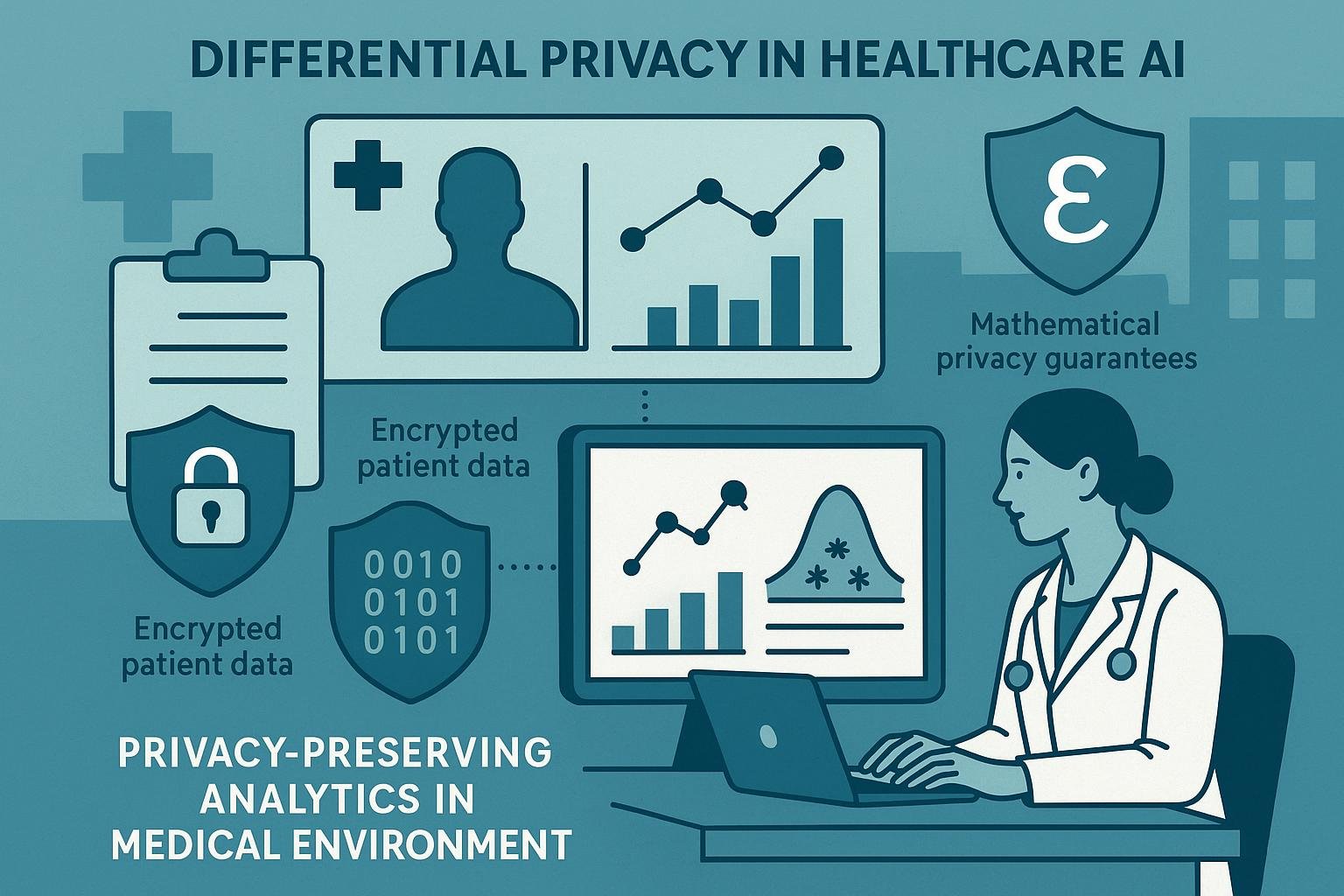
Today, we’ll explore how differential privacy is revolutionizing healthcare AI privacy protection, providing mathematical guarantees that go far beyond traditional privacy approaches. We’ll examine the technology, explore real-world implementations, and provide practical guidance for healthcare organizations seeking to implement differential privacy for their ambient clinical AI systems.
Understanding Differential Privacy: Mathematical Privacy Guarantees
Differential privacy represents a fundamental breakthrough in privacy protection, providing the first mathematically rigorous definition of privacy that can be quantified, measured, and guaranteed.
The Mathematical Foundation of Privacy
Traditional privacy approaches rely on intuitive notions of privacy protection—removing names, masking sensitive fields, or aggregating data to prevent individual identification. These approaches, while well-intentioned, provide no formal guarantees and have repeatedly been shown to be vulnerable to sophisticated attacks.
Differential privacy takes a fundamentally different approach by providing a mathematical definition of privacy that can be precisely measured and guaranteed:
Formal Definition: A randomized algorithm M satisfies ε-differential privacy if for all datasets D1 and D2 that differ by at most one individual, and for all possible outputs S:
“`
Pr[M(D1) ∈ S] ≤ exp(ε) × Pr[M(D2) ∈ S]
“`
What this means in practical terms:
- The presence or absence of any individual’s data has minimal impact on the algorithm’s output
- An attacker cannot determine whether a specific individual’s data was used in the analysis
- The privacy guarantee holds even against attackers with unlimited computational power and extensive background knowledge
The Privacy Budget: Quantifying Privacy Protection
One of the most powerful aspects of differential privacy is the concept of a “privacy budget” (ε, epsilon) that quantifies exactly how much privacy is being consumed by each analysis:
Lower ε values = Stronger privacy protection
- ε = 0.1: Very strong privacy protection
- ε = 1.0: Moderate privacy protection
- ε = 10.0: Weak privacy protection
Privacy Budget Consumption:
- Each query or analysis consumes part of the privacy budget
- Privacy budgets are cumulative—multiple analyses add up
- Once the budget is exhausted, no further analyses can be performed without compromising privacy
Healthcare Privacy Budget Guidelines:
“`
Recommended ε Values for Healthcare AI:
Research Applications: ε ≤ 1.0
- Population health studies
- Clinical research and trials
- Epidemiological analysis
Clinical Decision Support: ε ≤ 0.5
- Diagnostic assistance systems
- Treatment recommendation engines
- Risk prediction models
Highly Sensitive Applications: ε ≤ 0.1
- Mental health and substance abuse
- Genetic and genomic analysis
- Reproductive health applications
“`
How Differential Privacy Works in Ambient Clinical AI
Implementing differential privacy in ambient clinical AI systems requires careful consideration of where and how to add privacy protection throughout the AI pipeline.
Privacy Protection Points in the AI Pipeline
Training Data Protection:
“`
Differential Privacy in AI Training:
- Data Preprocessing
- Add noise to training datasets before model training
- Implement private data selection and filtering
- Use differentially private feature extraction
- Model Training
- Apply differentially private stochastic gradient descent (DP-SGD)
- Add calibrated noise to gradient updates
- Implement privacy-preserving optimization algorithms
- Model Evaluation
- Use differentially private validation and testing procedures
- Implement private model selection and hyperparameter tuning
- Apply privacy-preserving performance measurement
“`
Inference-Time Protection:
“`
Differential Privacy in AI Inference:
- Query Processing
- Add noise to individual query responses
- Implement private aggregation for multiple queries
- Use privacy-preserving result filtering
- Output Generation
- Apply differential privacy to clinical note generation
- Implement private confidence score reporting
- Use privacy-preserving result ranking and selection
- Analytics and Reporting
- Apply differential privacy to usage analytics
- Implement private performance monitoring
- Use privacy-preserving audit and compliance reporting
“`
Technical Implementation: Noise Mechanisms
Differential privacy works by adding carefully calibrated random noise to data or computations. The amount and type of noise depends on the specific privacy requirements and the sensitivity of the underlying data.
Laplace Mechanism:
The most common approach for numerical data, adding noise drawn from a Laplace distribution:
“`
Laplace Noise Implementation:
def add_laplace_noise(value, sensitivity, epsilon):
“””
Add Laplace noise to achieve ε-differential privacy
Args:
value: The true value to be protected
sensitivity: The maximum change in output from changing one individual
epsilon: The privacy parameter (smaller = more private)
Returns:
Noisy value that satisfies ε-differential privacy
“””
scale = sensitivity / epsilon
noise = numpy.random.laplace(0, scale)
return value + noise
# Example: Protecting patient count in clinical notes
true_patient_count = 1247
sensitivity = 1 # Adding/removing one patient changes count by 1
epsilon = 0.5 # Moderate privacy protection
noisy_count = add_laplace_noise(true_patient_count, sensitivity, epsilon)
“`
Gaussian Mechanism:
Used when stronger privacy guarantees are needed or when dealing with more complex data types:
“`
Gaussian Noise Implementation:
def add_gaussian_noise(value, sensitivity, epsilon, delta):
“””
Add Gaussian noise to achieve (ε,δ)-differential privacy
Args:
value: The true value to be protected
sensitivity: The maximum change in output from changing one individual
epsilon: The privacy parameter
delta: The failure probability (typically very small)
Returns:
Noisy value that satisfies (ε,δ)-differential privacy
“””
sigma = (sensitivity * sqrt(2 * log(1.25/delta))) / epsilon
noise = numpy.random.normal(0, sigma)
return value + noise
“`
Exponential Mechanism:
Used for selecting from discrete sets of options while preserving privacy:
“`
Exponential Mechanism Implementation:
def exponential_mechanism(candidates, utility_function, sensitivity, epsilon):
“””
Select from candidates using exponential mechanism
Args:
candidates: List of possible outputs
utility_function: Function that scores each candidate
sensitivity: Maximum change in utility from changing one individual
epsilon: The privacy parameter
Returns:
Selected candidate that satisfies ε-differential privacy
“””
scores = [utility_function(candidate) for candidate in candidates]
probabilities = [exp(epsilon * score / (2 * sensitivity)) for score in scores]
# Normalize probabilities and sample
total = sum(probabilities)
probabilities = [p / total for p in probabilities]
return numpy.random.choice(candidates, p=probabilities)
“`
Real-World Implementation: Case Studies in Healthcare
Several healthcare organizations have successfully implemented differential privacy for their ambient clinical AI systems, demonstrating both the challenges and benefits of this approach.
Case Study 1: Academic Medical Center Research Collaboration
Organization: A consortium of 8 academic medical centers
Objective: Enable collaborative research on ambient clinical AI while protecting patient privacy
Challenge: Traditional data sharing approaches violated privacy policies and regulatory requirements
Implementation Approach:
Phase 1: Privacy Requirements Analysis
- Conducted comprehensive privacy impact assessment
- Established privacy budget allocation across research projects
- Developed governance framework for privacy budget management
Phase 2: Technical Infrastructure Development
“`
Differential Privacy Infrastructure:
Central Privacy Server:
- Manages privacy budgets across all participating sites
- Implements privacy accounting and tracking
- Provides differential privacy APIs for researchers
Local Privacy Clients:
- Apply differential privacy to local data queries
- Enforce privacy budget constraints
- Generate privacy-preserving research outputs
Privacy Monitoring System:
- Tracks privacy budget consumption in real-time
- Alerts when privacy budgets approach limits
- Generates compliance reports for regulatory review
“`
Phase 3: Research Application Development
- Developed differentially private versions of common research queries
- Implemented privacy-preserving statistical analysis tools
- Created training materials for researchers on differential privacy
Results and Outcomes:
Privacy Protection:
- Achieved ε = 0.5 differential privacy across all research applications
- Zero privacy violations or data breaches during 18-month implementation
- Passed comprehensive privacy audits by external experts
Research Utility:
- Enabled 23 collaborative research projects that were previously impossible
- Maintained 85-95% statistical accuracy compared to non-private analyses
- Published 12 peer-reviewed papers using differentially private results
Operational Impact:
- Reduced legal review time for research collaborations by 70%
- Eliminated need for complex data use agreements
- Increased researcher satisfaction and collaboration rates
Key Lessons Learned:
- Privacy budget management requires careful planning and governance
- Researcher training and education are critical for successful adoption
- Technical infrastructure must be robust and user-friendly
- Regular privacy audits and monitoring are essential
Case Study 2: Regional Health System Quality Improvement
Organization: Regional health system with 15 hospitals
Objective: Use ambient clinical AI data for quality improvement while protecting patient privacy
Challenge: Quality improvement initiatives required detailed patient-level analysis that traditional privacy methods couldn’t support
Implementation Strategy:
Differential Privacy for Quality Metrics:
“`
Quality Improvement Privacy Framework:
Patient Safety Metrics:
- Medication error rates with ε = 0.3
- Hospital-acquired infection rates with ε = 0.5
- Readmission rates with ε = 0.4
Clinical Effectiveness Metrics:
- Treatment outcome measures with ε = 0.6
- Diagnostic accuracy rates with ε = 0.5
- Care pathway compliance with ε = 0.4
Patient Experience Metrics:
- Satisfaction scores with ε = 0.7
- Communication effectiveness with ε = 0.6
- Care coordination measures with ε = 0.5
“`
Privacy-Preserving Analytics Platform:
- Implemented automated differential privacy for all quality reports
- Developed privacy-preserving dashboards for clinical leaders
- Created privacy-aware alerting systems for quality issues
Results:
- Maintained clinical utility for 95% of quality improvement initiatives
- Achieved formal privacy guarantees for all patient-level analyses
- Reduced privacy review time for quality projects by 80%
- Enabled new types of cross-hospital quality comparisons
Advanced Differential Privacy Techniques for Healthcare
Beyond basic differential privacy implementation, several advanced techniques can provide additional benefits for healthcare organizations:
Local Differential Privacy
Concept: Apply differential privacy at the individual patient level before data ever leaves the local environment.
Healthcare Applications:
- Patient-controlled privacy for personal health data
- Privacy-preserving patient surveys and feedback
- Decentralized clinical research and data collection
Implementation Approach:
“`
Local Differential Privacy Implementation:
Patient Device Level:
- Apply differential privacy to ambient AI recordings before transmission
- Implement privacy-preserving voice analysis on mobile devices
- Use local differential privacy for patient-reported outcomes
Clinical Workstation Level:
- Apply differential privacy to clinical note generation
- Implement privacy-preserving clinical decision support
- Use local differential privacy for provider workflow analytics
“`
Benefits:
- Provides privacy protection even if central systems are compromised
- Gives patients direct control over their privacy protection
- Reduces trust requirements for central data processing
Challenges:
- Requires more noise addition, potentially reducing utility
- Increases complexity of implementation and management
- May require specialized hardware or software at endpoints
Differential Privacy with Federated Learning
Concept: Combine differential privacy with federated learning to provide multiple layers of privacy protection.
Technical Implementation:
“`
Federated Differential Privacy:
Local Training with Differential Privacy:
- Apply differential privacy to local model training
- Add noise to gradient updates before sharing
- Implement privacy budget management across training rounds
Central Aggregation with Privacy Protection:
- Use differentially private aggregation algorithms
- Apply additional privacy protection during model combination
- Implement privacy-preserving model validation and testing
“`
Healthcare Benefits:
- Provides formal privacy guarantees for collaborative AI development
- Enables multi-site research with mathematical privacy protection
- Reduces trust requirements between participating organizations
Adaptive Differential Privacy
Concept: Dynamically adjust privacy parameters based on data sensitivity and usage patterns.
Implementation Framework:
“`
Adaptive Privacy Management:
Sensitivity-Based Adaptation:
- Automatically adjust ε based on data sensitivity classification
- Implement dynamic privacy budgets for different data types
- Use machine learning to optimize privacy-utility trade-offs
Usage-Based Adaptation:
- Adjust privacy parameters based on query patterns
- Implement privacy budget recycling for repeated analyses
- Use temporal privacy budgets for time-sensitive applications
“`
Healthcare Applications:
- Higher privacy protection for sensitive conditions (mental health, substance abuse)
- Dynamic privacy adjustment based on patient consent preferences
- Adaptive privacy for emergency vs. routine clinical scenarios
The Privacy-Utility Trade-off: Optimizing for Healthcare
One of the most critical aspects of implementing differential privacy in healthcare is optimizing the trade-off between privacy protection and clinical utility.
Understanding the Trade-off
Privacy vs. Utility Relationship:
- Stronger privacy protection (lower ε) requires more noise addition
- More noise reduces the accuracy and utility of AI systems
- Healthcare applications require careful balance to maintain clinical effectiveness
Factors Affecting the Trade-off:
“`
Privacy-Utility Optimization Factors:
Data Characteristics:
- Dataset size and diversity
- Signal-to-noise ratio in clinical data
- Correlation structure and feature relationships
Application Requirements:
- Required accuracy for clinical decision-making
- Tolerance for uncertainty in AI outputs
- Regulatory and compliance requirements
Privacy Constraints:
- Patient expectations and consent preferences
- Organizational privacy policies
- Legal and regulatory privacy requirements
“`
Optimization Strategies
Strategy 1: Adaptive Privacy Budgets
Allocate privacy budgets based on clinical importance and sensitivity:
“`
Clinical Priority-Based Privacy Allocation:
Critical Clinical Applications (ε = 0.1-0.3):
- Emergency diagnosis and treatment
- Life-threatening condition detection
- Critical medication dosing decisions
Important Clinical Applications (ε = 0.3-0.7):
- Routine diagnosis and treatment planning
- Preventive care recommendations
- Quality improvement initiatives
Research and Analytics (ε = 0.7-1.0):
- Population health studies
- Clinical research and trials
- Operational analytics and reporting
“`
Strategy 2: Hierarchical Privacy Protection
Implement different privacy levels for different types of information:
“`
Hierarchical Privacy Framework:
Highly Sensitive Information (ε ≤ 0.1):
- Mental health and psychiatric conditions
- Substance abuse and addiction treatment
- Genetic and genomic information
- Reproductive health and family planning
Moderately Sensitive Information (ε ≤ 0.5):
- Chronic disease management
- Medication and treatment history
- Diagnostic test results and imaging
General Medical Information (ε ≤ 1.0):
- Routine vital signs and measurements
- General health maintenance activities
- Administrative and scheduling information
“`
Strategy 3: Utility-Preserving Noise Addition
Use advanced techniques to minimize the impact of noise on clinical utility:
“`
Advanced Noise Optimization:
Correlated Noise Addition:
- Add noise that preserves important clinical relationships
- Use domain knowledge to guide noise distribution
- Implement structure-preserving privacy mechanisms
Selective Privacy Application:
- Apply differential privacy only to sensitive data elements
- Use traditional privacy methods for less sensitive information
- Implement hybrid privacy protection approaches
Post-Processing Optimization:
- Use privacy-preserving post-processing to improve utility
- Implement consistency constraints for clinical data
- Apply domain-specific optimization techniques
“`
Measuring and Validating Differential Privacy Implementation
Successful differential privacy implementation requires comprehensive measurement and validation to ensure both privacy protection and clinical utility.
Privacy Protection Validation
Mathematical Verification:
“`
Privacy Guarantee Validation:
Formal Privacy Analysis:
- Verify ε-differential privacy guarantees mathematically
- Conduct composition analysis for multiple queries
- Validate privacy budget accounting and management
Empirical Privacy Testing:
- Conduct membership inference attack testing
- Perform reconstruction attack simulations
- Test privacy protection against known attack methods
Regulatory Compliance Verification:
- Validate compliance with healthcare privacy regulations
- Conduct privacy impact assessments and audits
- Verify alignment with organizational privacy policies
“`
Privacy Monitoring and Alerting:
“`
Continuous Privacy Monitoring:
Real-Time Privacy Budget Tracking:
- Monitor privacy budget consumption across all applications
- Alert when privacy budgets approach predefined limits
- Implement automatic privacy budget renewal and management
Privacy Violation Detection:
- Monitor for potential privacy violations or breaches
- Detect unusual query patterns that might indicate attacks
- Implement automated response procedures for privacy incidents
Compliance Reporting:
- Generate regular privacy compliance reports
- Track privacy metrics and key performance indicators
- Provide audit trails for regulatory review and validation
“`
Clinical Utility Assessment
Accuracy and Performance Metrics:
“`
Clinical Utility Validation Framework:
Diagnostic Accuracy:
- Compare differentially private vs. non-private diagnostic accuracy
- Measure sensitivity and specificity for clinical conditions
- Assess impact on clinical decision-making quality
Treatment Effectiveness:
- Evaluate impact on treatment recommendation accuracy
- Measure patient outcome improvements or degradation
- Assess clinical workflow efficiency and effectiveness
Research and Analytics Utility:
- Compare research results with and without differential privacy
- Measure statistical power and significance of findings
- Assess impact on clinical research and quality improvement
“`
Clinical Validation Studies:
“`
Clinical Validation Protocol:
Retrospective Analysis:
- Compare historical clinical outcomes with differential privacy implementation
- Analyze impact on diagnostic accuracy and treatment effectiveness
- Measure changes in clinical workflow and efficiency
Prospective Studies:
- Conduct controlled studies of differential privacy impact
- Measure patient outcomes and safety metrics
- Assess clinician satisfaction and adoption rates
Continuous Monitoring:
- Implement ongoing clinical utility monitoring
- Track key clinical performance indicators
- Conduct regular clinical validation and assessment
“`
Implementation Best Practices for Healthcare Organizations
Based on successful implementations across multiple healthcare organizations, several best practices have emerged for differential privacy deployment:
Organizational Readiness and Governance
Privacy Governance Framework:
“`
Differential Privacy Governance Structure:
Executive Sponsorship:
- Chief Privacy Officer or Chief Data Officer leadership
- Executive committee oversight and decision-making
- Board-level privacy risk management and reporting
Cross-Functional Privacy Committee:
- Clinical leadership representation
- IT and data science expertise
- Legal and compliance oversight
- Patient advocacy and ethics input
Privacy Budget Management:
- Centralized privacy budget allocation and tracking
- Application-specific privacy requirements and constraints
- Regular privacy budget review and optimization
- Emergency privacy budget procedures and protocols
“`
Staff Training and Education:
“`
Comprehensive Training Program:
Technical Training:
- Differential privacy concepts and mathematics
- Implementation tools and techniques
- Privacy budget management and optimization
- Troubleshooting and problem resolution
Clinical Training:
- Impact of differential privacy on clinical workflows
- Interpretation of privacy-protected results
- Clinical decision-making with privacy constraints
- Patient communication about privacy protection
Compliance Training:
- Regulatory requirements and compliance obligations
- Privacy audit and assessment procedures
- Incident response and breach notification
- Documentation and reporting requirements
“`
Technical Implementation Guidelines
Infrastructure Requirements:
“`
Differential Privacy Infrastructure:
Computing Resources:
- Sufficient computational power for noise generation and privacy calculations
- Secure random number generation capabilities
- High-performance computing for large-scale privacy applications
Security Controls:
- Secure key management for privacy parameter storage
- Access controls for privacy budget management systems
- Audit logging for all privacy-related activities
- Encryption for privacy-sensitive communications
Monitoring and Alerting:
- Real-time privacy budget monitoring and alerting
- Performance monitoring for privacy-protected applications
- Security monitoring for privacy-related threats
- Compliance monitoring and reporting capabilities
“`
Development and Testing Procedures:
“`
Privacy-Aware Development Lifecycle:
Privacy-by-Design Development:
- Integrate differential privacy into application design
- Implement privacy requirements from the beginning
- Use privacy-preserving development and testing practices
Privacy Testing and Validation:
- Comprehensive privacy testing before deployment
- Validation of privacy guarantees and utility preservation
- Performance testing with privacy protection enabled
- Security testing for privacy-related vulnerabilities
Deployment and Operations:
- Staged deployment with privacy monitoring
- Continuous privacy validation and monitoring
- Regular privacy audits and assessments
- Incident response procedures for privacy events
“`
The Future of Differential Privacy in Healthcare
Differential privacy is rapidly evolving, with new techniques and applications emerging that will further enhance privacy protection in healthcare AI:
Emerging Technologies and Techniques
Machine Learning for Privacy Optimization:
- AI systems that automatically optimize privacy-utility trade-offs
- Machine learning approaches to privacy budget allocation
- Automated privacy parameter tuning and optimization
Quantum-Safe Differential Privacy:
- Privacy protection that remains secure against quantum computing attacks
- Post-quantum cryptographic techniques for privacy protection
- Quantum-enhanced privacy mechanisms and protocols
Federated Differential Privacy:
- Advanced techniques for combining federated learning with differential privacy
- Cross-organizational privacy protection and collaboration
- Distributed privacy budget management and optimization
Regulatory and Standards Development
Healthcare-Specific Privacy Standards:
- Development of healthcare-specific differential privacy standards
- Regulatory guidance for differential privacy in clinical applications
- Industry best practices and implementation guidelines
International Privacy Harmonization:
- Alignment of differential privacy approaches across international jurisdictions
- Cross-border privacy protection and data sharing frameworks
- Global standards for healthcare privacy protection
Take Action: Implement Mathematical Privacy Protection
Differential privacy represents the gold standard for privacy protection in healthcare AI, providing mathematical guarantees that go far beyond traditional privacy approaches. Don’t settle for privacy protection that relies on hope rather than mathematical certainty.
Download our Differential Privacy Implementation Toolkit to get started with practical tools and resources:
- Privacy budget calculation and optimization tools
- Technical implementation guides and code examples
- Clinical utility assessment frameworks and procedures
- Regulatory compliance checklists and documentation templates
- Training materials and educational resources
[Download the Differential Privacy Toolkit →]()
Ready to implement mathematical privacy protection? Our team of differential privacy experts can help you assess your privacy requirements and develop a customized implementation strategy that balances privacy protection with clinical utility.
[Schedule Your Differential Privacy Consultation →]()
Join our privacy engineering community to connect with other healthcare organizations implementing advanced privacy protection and share best practices and lessons learned.
[Join the Privacy Engineering Community →]()
*This is Part 6 of our 12-part series on securing ambient clinical note AI systems. In our next article, we’ll explore homomorphic encryption and how it enables computation on encrypted patient data without ever decrypting it.*
Coming Next Week: “Homomorphic Encryption for Healthcare AI: Computing on Encrypted Patient Data”
About EncryptCentral: We are the leading cybersecurity consulting firm specializing in healthcare AI security and privacy-preserving technologies. Our team includes differential privacy researchers, privacy engineers, and healthcare AI specialists who can help you implement mathematical privacy protection while maintaining clinical utility.
*Questions about implementing differential privacy for your ambient clinical AI systems? Our expert privacy engineering team can guide you through every aspect of implementation, from privacy budget optimization to clinical utility validation.*
Ready to Secure Your Healthcare AI Systems?
Get our comprehensive Healthcare AI Security Assessment Toolkit—a $5,000 value, absolutely free. This toolkit includes:
- ✓ 23-Point AI Security Risk Assessment Checklist
- ✓ HIPAA Compliance Framework for AI Systems
- ✓ Incident Response Playbook for AI Security Events
- ✓ ROI Calculator for AI Security Investments