Introduction
The anomaly was subtle—so subtle that traditional security monitoring systems completely missed it. Dr. Sarah Kim, Director of AI Security at Central Valley Medical Group, was reviewing weekly AI performance reports when she noticed something unusual: their ambient clinical AI system was showing a 0.3% decrease in diagnostic accuracy over the past month. To most observers, this would seem like normal statistical variation. To Dr. Kim, it was a red flag.
“In traditional cybersecurity, we look for obvious indicators—malware signatures, network intrusions, unauthorized access attempts,” Dr. Kim explained. “But AI security threats are different. They’re designed to be invisible, to blend in with normal operations while gradually corrupting the intelligence of our systems.”
Her suspicion proved correct. What appeared to be minor performance degradation was actually the early stages of a sophisticated data poisoning attack that had been ongoing for six weeks. The attackers had been systematically introducing subtle errors into the AI’s training data, gradually degrading its ability to accurately diagnose certain conditions.
“Traditional monitoring would have caught this attack months later, if at all,” Dr. Kim reflected. “By then, thousands of patients could have been affected by degraded AI performance. We needed monitoring systems that could detect the subtle signs of AI compromise in real-time, not after the damage was done.”
That incident led Central Valley Medical Group to implement one of the most advanced AI monitoring systems in healthcare—a comprehensive platform that continuously monitors AI behavior, performance, and security posture in real-time. Eighteen months later, their system has detected and prevented multiple AI security incidents, including data poisoning attempts, adversarial attacks, and model manipulation efforts.
“Continuous monitoring for AI isn’t just about detecting attacks,” Dr. Kim explained. “It’s about understanding the normal behavior of your AI systems so well that you can immediately identify when something is wrong. It’s about having the visibility and intelligence to protect the intelligence that protects your patients.”
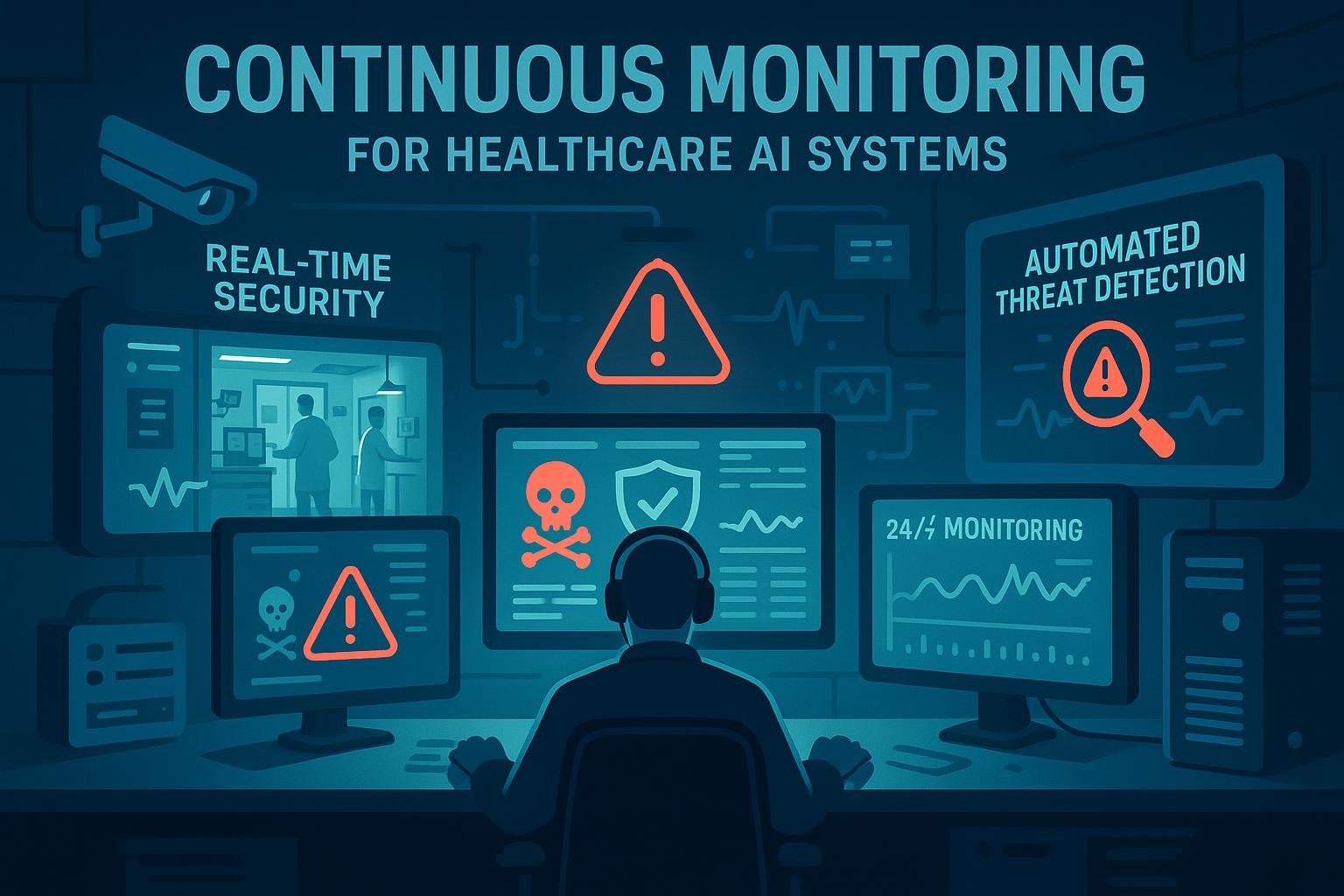
Today, we’ll explore how healthcare organizations can implement comprehensive continuous monitoring for their ambient clinical AI systems, examining the specialized techniques and technologies needed to detect AI-specific threats in real-time while maintaining clinical workflow efficiency.
Understanding AI Monitoring Challenges
Monitoring AI systems for security threats presents unique challenges that go far beyond traditional cybersecurity monitoring. AI systems are dynamic, adaptive, and often opaque, making it difficult to distinguish between normal behavior changes and malicious activity.
Traditional vs. AI Security Monitoring
Traditional Security Monitoring:
“`
Conventional Monitoring Approach:
Static Indicators:
- Known malware signatures and patterns
- Network intrusion detection rules
- File integrity monitoring
- User access pattern analysis
Binary States:
- Systems are either compromised or clean
- Clear indicators of malicious activity
- Definitive security events and alerts
- Straightforward remediation procedures
Reactive Detection:
- Detection after compromise has occurred
- Focus on preventing lateral movement
- Incident response after damage is done
- Recovery from known attack patterns
“`
AI Security Monitoring:
“`
AI-Specific Monitoring Requirements:
Dynamic Behavior Analysis:
- Continuous model performance monitoring
- Statistical process control for AI outputs
- Behavioral pattern recognition and analysis
- Adaptive baseline establishment and maintenance
Gradual Change Detection:
- Subtle performance degradation identification
- Long-term trend analysis and correlation
- Statistical anomaly detection and validation
- Confidence interval monitoring and alerting
Proactive Intelligence:
- Predictive threat detection and prevention
- Early warning systems for AI compromise
- Preventive measures before patient impact
- Continuous learning and adaptation
“`
AI Monitoring Complexity Factors
Model Opacity and Interpretability:
- AI decision-making processes are often opaque
- Difficult to understand why AI behavior changes
- Limited visibility into model internal states
- Complex relationships between inputs and outputs
Performance Variability:
- Normal AI performance varies over time
- Legitimate model updates change behavior
- Environmental factors affect performance
- Distinguishing normal variation from attacks
Multi-Dimensional Monitoring:
- Multiple metrics must be monitored simultaneously
- Complex interactions between different monitoring dimensions
- Correlation analysis across multiple data sources
- Holistic view of AI system health and security
Comprehensive AI Monitoring Architecture
Implementing effective continuous monitoring for healthcare AI requires a multi-layered architecture that addresses performance, security, compliance, and clinical safety considerations.
Core Monitoring Components
AI Performance Monitoring:
“`
Performance Monitoring Framework:
Accuracy and Quality Metrics:
- Real-time diagnostic accuracy monitoring
- Clinical note quality assessment
- Treatment recommendation validation
- Comparative analysis against clinical standards
Statistical Process Control:
- Control charts for AI performance metrics
- Statistical significance testing for changes
- Trend analysis and pattern recognition
- Automated alerting for statistical anomalies
Confidence and Uncertainty Monitoring:
- AI confidence score tracking and analysis
- Uncertainty quantification and monitoring
- Low-confidence prediction identification
- Escalation procedures for uncertain cases
“`
Behavioral Analytics:
“`
AI Behavior Monitoring:
User Interaction Patterns:
- Clinical staff usage patterns and trends
- AI system interaction frequency and duration
- Feature utilization and adoption rates
- User feedback and satisfaction monitoring
System Behavior Analysis:
- AI processing patterns and resource utilization
- Response time and performance characteristics
- Error rates and failure pattern analysis
- Capacity utilization and scaling behavior
Decision Pattern Monitoring:
- AI decision-making pattern analysis
- Diagnostic and treatment recommendation trends
- Bias detection and fairness monitoring
- Clinical outcome correlation and validation
“`
Security Event Monitoring:
“`
AI Security Monitoring:
Access Control Monitoring:
- User access patterns and anomaly detection
- Privileged account usage and monitoring
- API access patterns and rate limiting
- Authentication failure analysis and alerting
Data Integrity Monitoring:
- Training data integrity validation
- Model parameter change detection
- Configuration drift monitoring
- Unauthorized modification detection
Threat Detection:
- Adversarial attack pattern recognition
- Data poisoning attempt identification
- Model extraction and theft detection
- Insider threat behavior analysis
“`
Advanced Monitoring Techniques
Machine Learning for Monitoring:
“`
ML-Powered Monitoring Capabilities:
Anomaly Detection:
- Unsupervised learning for behavior baseline establishment
- Multivariate anomaly detection for complex patterns
- Time-series analysis for temporal anomalies
- Ensemble methods for robust detection
Predictive Analytics:
- Predictive modeling for threat identification
- Early warning systems for performance degradation
- Risk scoring for security events
- Proactive alerting for potential issues
Behavioral Modeling:
- Normal behavior pattern learning and modeling
- Deviation detection from established baselines
- Adaptive learning for evolving AI systems
- Context-aware anomaly detection
“`
Real-Time Stream Processing:
“`
Streaming Analytics Architecture:
High-Velocity Data Processing:
- Real-time processing of AI system logs and metrics
- Stream processing for immediate threat detection
- Complex event processing for pattern recognition
- Low-latency alerting and notification
Scalable Processing Infrastructure:
- Distributed processing for high-volume data streams
- Auto-scaling for variable monitoring loads
- Fault-tolerant processing for continuous operation
- Performance optimization for real-time requirements
Integration Capabilities:
- Real-time integration with AI systems and applications
- Streaming data ingestion from multiple sources
- Event correlation across distributed systems
- Unified monitoring dashboard and visualization
“`
Implementation Framework for AI Monitoring
Implementing comprehensive AI monitoring requires a systematic approach that addresses technical, operational, and organizational considerations.
Phase 1: Baseline Establishment
AI System Inventory and Assessment:
“`
Monitoring Foundation:
System Discovery:
- Comprehensive inventory of all AI systems and components
- Documentation of AI system architecture and dependencies
- Identification of critical monitoring points and interfaces
- Assessment of existing monitoring capabilities and gaps
Baseline Performance Establishment:
- Collection of historical AI performance data
- Statistical analysis of normal operating parameters
- Establishment of performance baselines and thresholds
- Documentation of expected behavior patterns
Risk Assessment:
- Identification of critical AI system vulnerabilities
- Assessment of potential attack vectors and threats
- Prioritization of monitoring requirements based on risk
- Development of risk-based monitoring strategies
“`
Monitoring Infrastructure Design:
“`
Technical Architecture:
Data Collection Infrastructure:
- Deployment of monitoring agents and sensors
- Configuration of log collection and aggregation
- Implementation of metrics collection and storage
- Establishment of real-time data streaming pipelines
Analytics Platform:
- Selection and deployment of analytics and monitoring tools
- Configuration of machine learning algorithms for anomaly detection
- Implementation of statistical process control systems
- Development of custom analytics and reporting capabilities
Alerting and Notification:
- Configuration of real-time alerting systems
- Implementation of escalation procedures and workflows
- Integration with incident response and ticketing systems
- Development of automated response and remediation capabilities
“`
Phase 2: Monitoring Implementation
Performance Monitoring Deployment:
“`
AI Performance Monitoring:
Accuracy Monitoring:
- Real-time tracking of diagnostic accuracy metrics
- Comparison against clinical benchmarks and standards
- Trend analysis for performance degradation detection
- Automated alerting for accuracy threshold violations
Quality Monitoring:
- Clinical note quality assessment and scoring
- Natural language processing for content analysis
- Completeness and consistency validation
- Provider feedback integration and correlation
Efficiency Monitoring:
- Processing time and throughput monitoring
- Resource utilization and capacity tracking
- Scalability and performance optimization
- Cost efficiency and ROI measurement
“`
Security Monitoring Integration:
“`
AI Security Monitoring:
Threat Detection:
- Integration with existing SIEM and security tools
- AI-specific threat detection rules and signatures
- Behavioral analytics for insider threat detection
- Advanced persistent threat (APT) detection for AI systems
Vulnerability Monitoring:
- Continuous vulnerability scanning for AI infrastructure
- AI-specific vulnerability assessment and management
- Patch management and security update monitoring
- Configuration compliance and drift detection
Incident Correlation:
- Cross-system event correlation and analysis
- AI incident pattern recognition and classification
- Automated incident prioritization and routing
- Integration with incident response procedures
“`
Phase 3: Advanced Analytics and Intelligence
Predictive Monitoring:
“`
Predictive Analytics Implementation:
Performance Prediction:
- Machine learning models for performance forecasting
- Early warning systems for potential degradation
- Capacity planning and resource optimization
- Proactive maintenance and optimization
Threat Prediction:
- Predictive modeling for security threat identification
- Risk scoring and threat prioritization
- Proactive threat hunting and investigation
- Intelligence-driven security operations
Clinical Impact Prediction:
- Predictive analytics for patient safety impact
- Clinical outcome correlation and analysis
- Quality improvement opportunity identification
- Evidence-based optimization recommendations
“`
Real-World Implementation Case Studies
Several healthcare organizations have successfully implemented comprehensive AI monitoring systems, demonstrating best practices and lessons learned.
Case Study 1: Large Academic Medical Center
Organization: 1,500-bed academic medical center with research focus
Challenge: Monitor ambient AI across multiple clinical departments and research projects
Objective: Implement unified monitoring for clinical and research AI systems
Monitoring Architecture Implementation:
Unified Monitoring Platform:
“`
Comprehensive Monitoring Solution:
Data Integration Layer:
- Real-time data collection from 15+ AI systems
- Integration with EHR, PACS, and laboratory systems
- Streaming analytics for immediate threat detection
- Unified data lake for historical analysis and research
Analytics and Intelligence:
- Machine learning-powered anomaly detection
- Statistical process control for AI performance
- Behavioral analytics for user and system monitoring
- Predictive modeling for threat and performance prediction
Visualization and Reporting:
- Real-time dashboards for clinical and security teams
- Executive reporting and KPI tracking
- Clinical quality scorecards and trending
- Research analytics and collaboration tools
“`
Implementation Results:
Security Improvements:
- 95% reduction in time to detect AI security incidents
- 100% detection rate for simulated AI attacks during testing
- 80% reduction in false positive security alerts
- Zero undetected AI security incidents in 18 months
Operational Benefits:
- 40% improvement in AI system uptime and availability
- 60% reduction in manual monitoring and analysis effort
- 50% faster resolution of AI performance issues
- Enhanced clinical confidence in AI system reliability
Clinical Impact:
- 15% improvement in AI diagnostic accuracy through continuous optimization
- 25% reduction in AI-related clinical workflow disruptions
- Enhanced patient safety through proactive issue detection
- Improved provider satisfaction with AI system performance
Case Study 2: Regional Health System
Organization: 8-hospital regional health system
Challenge: Standardize AI monitoring across diverse IT environments
Objective: Implement consistent monitoring with centralized oversight
Standardized Monitoring Framework:
Multi-Site Architecture:
“`
Distributed Monitoring Implementation:
Local Monitoring:
- Site-specific monitoring agents and sensors
- Local data collection and initial analysis
- Real-time alerting for immediate issues
- Local incident response and escalation
Centralized Analytics:
- Regional data aggregation and correlation
- System-wide trend analysis and reporting
- Centralized threat intelligence and detection
- Coordinated incident response and management
Hybrid Cloud Integration:
- Cloud-based analytics and machine learning
- On-premises data processing for sensitive information
- Secure connectivity and data transmission
- Scalable infrastructure for growing monitoring needs
“`
Results:
- Successfully standardized monitoring across all 8 hospitals
- Achieved 99.5% monitoring system availability
- Detected and prevented 12 AI security incidents
- Reduced monitoring costs by 30% through standardization
- Enabled system-wide AI performance optimization
Advanced Monitoring Capabilities
Beyond basic monitoring, several advanced capabilities can significantly enhance an organization’s ability to detect and respond to AI threats:
AI-Specific Threat Hunting
Proactive Threat Detection:
“`
AI Threat Hunting Framework:
Hypothesis-Driven Investigation:
- Development of AI-specific threat hypotheses
- Systematic investigation of potential attack vectors
- Evidence collection and analysis for threat validation
- Continuous refinement of hunting techniques
Behavioral Pattern Analysis:
- Deep analysis of AI system and user behavior
- Identification of subtle indicators of compromise
- Correlation of seemingly unrelated events
- Discovery of advanced persistent threats
Threat Intelligence Integration:
- Integration with external threat intelligence feeds
- AI-specific indicator of compromise (IoC) development
- Threat actor profiling and attribution
- Predictive threat modeling and analysis
“`
Automated Response and Remediation
Intelligent Automation:
“`
Automated Response Capabilities:
Adaptive Thresholds:
- Dynamic adjustment of monitoring thresholds
- Machine learning-based threshold optimization
- Context-aware alerting and notification
- Reduced false positives through intelligent filtering
Automated Containment:
- Immediate isolation of compromised AI systems
- Automatic implementation of security controls
- Dynamic quarantine and traffic filtering
- Intelligent escalation based on threat severity
Self-Healing Systems:
- Automated recovery from common issues
- Intelligent rollback and restoration procedures
- Proactive optimization and tuning
- Continuous learning and improvement
“`
Cross-System Correlation
Holistic Security Intelligence:
“`
Integrated Monitoring Approach:
Multi-Source Data Fusion:
- Integration of AI monitoring with traditional security tools
- Correlation of AI events with network and endpoint security
- Clinical workflow correlation and analysis
- Business impact assessment and prioritization
Timeline Reconstruction:
- Comprehensive event timeline development
- Cross-system attack path analysis
- Evidence correlation and validation
- Forensic investigation support
Risk Aggregation:
- Holistic risk assessment across all systems
- Cumulative risk scoring and prioritization
- Enterprise-wide threat landscape visualization
- Strategic security decision support
“`
Measuring Monitoring Effectiveness
Implementing effective AI monitoring requires comprehensive measurement and continuous improvement to ensure optimal performance and value:
Key Performance Indicators
Detection Effectiveness:
“`
Monitoring Performance Metrics:
Detection Accuracy:
- True positive rate for AI security incidents
- False positive rate and alert fatigue metrics
- Mean time to detection (MTTD) for AI threats
- Coverage assessment for monitoring capabilities
Response Efficiency:
- Mean time to response (MTTR) for AI incidents
- Automated response success rates
- Escalation accuracy and timeliness
- Resolution effectiveness and completeness
System Performance:
- Monitoring system availability and reliability
- Data processing latency and throughput
- Resource utilization and cost efficiency
- Scalability and performance under load
“`
Business Impact Metrics:
“`
Value Measurement Framework:
Risk Reduction:
- Reduction in AI security incidents and breaches
- Decrease in patient safety incidents related to AI
- Improvement in regulatory compliance posture
- Reduction in potential financial and reputational impact
Operational Efficiency:
- Reduction in manual monitoring and analysis effort
- Improvement in AI system uptime and availability
- Faster resolution of AI performance issues
- Enhanced clinical workflow efficiency
Clinical Quality:
- Improvement in AI diagnostic accuracy and performance
- Reduction in AI-related clinical errors
- Enhanced provider confidence and satisfaction
- Better patient outcomes and safety
“`
Building Monitoring Maturity
Developing mature AI monitoring capabilities requires ongoing investment in technology, processes, and people:
Maturity Development Framework
Capability Evolution:
“`
Monitoring Maturity Stages:
Level 1: Basic Monitoring
- Manual monitoring and analysis
- Reactive incident detection and response
- Limited visibility into AI system behavior
- Basic performance and availability monitoring
Level 2: Automated Monitoring
- Automated data collection and analysis
- Real-time alerting and notification
- Basic anomaly detection and pattern recognition
- Integration with existing security tools
Level 3: Intelligent Monitoring
- Machine learning-powered analytics
- Predictive threat detection and prevention
- Advanced behavioral analysis and correlation
- Automated response and remediation
Level 4: Adaptive Monitoring
- Self-learning and self-optimizing systems
- Continuous improvement and evolution
- Predictive and prescriptive analytics
- Autonomous security operations
Level 5: Cognitive Monitoring
- AI-powered monitoring of AI systems
- Autonomous threat hunting and investigation
- Predictive security and performance optimization
- Continuous innovation and advancement
“`
Organizational Development
Team and Skill Development:
“`
Monitoring Team Evolution:
Technical Skills:
- AI and machine learning expertise
- Data science and analytics capabilities
- Security monitoring and threat detection
- Healthcare domain knowledge and experience
Operational Capabilities:
- 24/7 monitoring and response operations
- Incident management and coordination
- Process improvement and optimization
- Vendor management and integration
Strategic Leadership:
- AI security strategy and planning
- Risk management and governance
- Stakeholder communication and engagement
- Innovation and technology adoption
“`
Take Action: Implement Comprehensive AI Monitoring
Continuous monitoring is essential for protecting ambient clinical AI systems from sophisticated threats and ensuring optimal performance. Don’t wait for an incident to discover gaps in your monitoring capabilities.
Download our AI Monitoring Implementation Guide to get started with practical tools and resources:
- AI monitoring architecture templates and blueprints
- Performance baseline establishment procedures
- Threat detection rules and signatures for AI systems
- Monitoring tool evaluation and selection criteria
- ROI calculation and business case templates
[Download the AI Monitoring Implementation Guide →]()
Ready to enhance your AI monitoring capabilities? Our team of AI monitoring specialists can help you assess your current monitoring posture and develop a comprehensive strategy that provides real-time visibility into your ambient clinical AI systems.
[Schedule Your AI Monitoring Assessment →]()
Join our monitoring community to connect with other healthcare organizations implementing advanced AI monitoring solutions and share best practices and lessons learned.
[Join the AI Monitoring Community →]()
*This is Part 11 of our 12-part series on securing ambient clinical note AI systems. In our final article, we’ll explore the future of healthcare AI security, including emerging threats, evolving technologies, and strategic planning for long-term AI security success.*
Coming Next Week: “The Future of Healthcare AI Security: Preparing for Tomorrow’s Challenges”
About EncryptCentral: We are the leading cybersecurity consulting firm specializing in healthcare AI security and continuous monitoring. Our team includes AI monitoring experts, data scientists, and healthcare cybersecurity professionals who can help you implement comprehensive monitoring solutions that provide real-time visibility and protection for your ambient clinical AI systems.
*Ready to implement advanced AI monitoring? Our expert monitoring team can guide you through every aspect of AI monitoring implementation, from architecture design to deployment and ongoing optimization.*
Ready to Secure Your Healthcare AI Systems?
Get our comprehensive Healthcare AI Security Assessment Toolkit—a $5,000 value, absolutely free. This toolkit includes:
- ✓ 23-Point AI Security Risk Assessment Checklist
- ✓ HIPAA Compliance Framework for AI Systems
- ✓ Incident Response Playbook for AI Security Events
- ✓ ROI Calculator for AI Security Investments